
Suppose a lot owner in Vancouver wonders whether a multiplex (a building of several homes on one residential lot) can be built on the property, and types the question into Google. This article shows four screenshots of what such a person finds on Google and on Microsoft's Bing, and the same website appears in all four: VanPlex. We explain each result in Google's and Microsoft's own words, and then ask what the same work would look like for a casita builder in Phoenix, or for a custom home builder in Florida.
First, a plain disclosure. VanPlex is a Vancouver multiplex builder and developer site, and it is one of the properties where Licheo's team tests its methods first. Licheo's published description of itself says "We test every feature on our own properties first", and names VanPlex among them. The screenshots are therefore a company's own record of its own test site, and we ask you to read them as such. Each one records one search on one day.
What did VanPlex change on its website?
Our case study records the work in three lines. The site was reorganized around one subject, multiplex development, so that its pages match what people type when they want a multiplex built. Its service pages were aligned with the searches people make when they intend to hire a developer. And the technical faults that had accumulated on the site were cleaned up, and the structure of the pages was made clearer. The record gives no further detail, and we add none here.
The results, as the screenshots on our case studies page record them:
| Search or report | Where | What the screenshot shows | |---|---|---| | "multiplex developer vancouver" | Google | VanPlex holds the featured snippet and the top unpaid (organic) placement | | "Multiplex vancouver map" | Google | VanPlex ranks first, with its permits map page | | "multiplex co-development" | Google's AI Overview | VanPlex is cited as a source | | AI Performance report, one seven-day period | Bing Webmaster Tools | 311 total citations and 13 average cited pages |
What is a featured snippet, and which VanPlex page holds it?
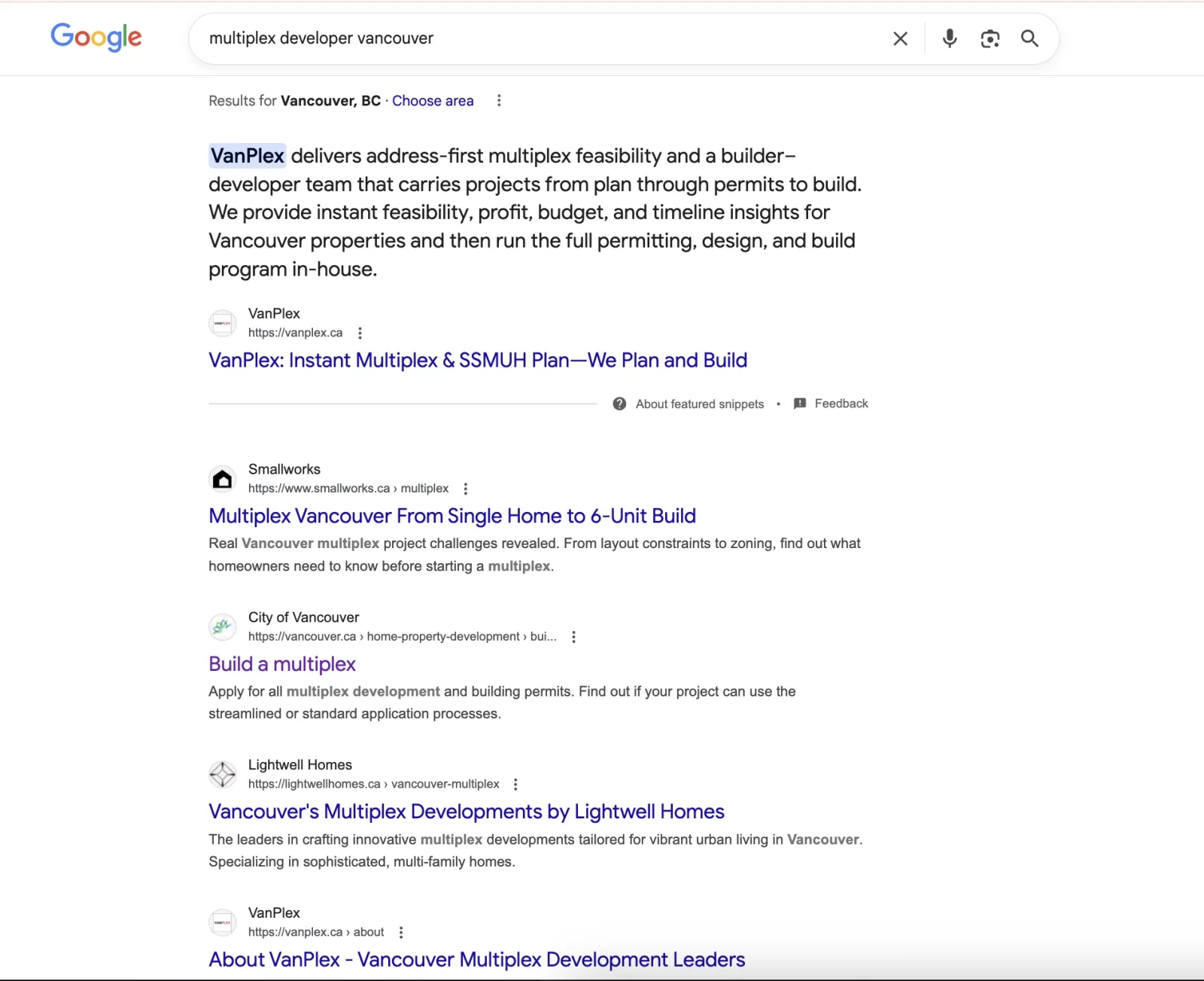
Google defines the term: "Featured snippets are special boxes where the format of a regular search result is reversed, showing the descriptive snippet first." An ordinary result shows the title and then a short description; a featured snippet shows the description first, in a box. In our screenshot, the box stands above every other result.
Can a business ask for this box? To the question "How can I mark my page as a featured snippet?", Google's answer is two words: "You can't." Google's systems decide whether a page would make a good featured snippet for a given search.
The text in the box is a plain description of what VanPlex does for Vancouver properties, and the link under it goes to the homepage, vanplex.ca. The page that holds the snippet is therefore the homepage, and the words Google took are the sentences that say what the business does and where.
Which page ranks first for "Multiplex vancouver map"?
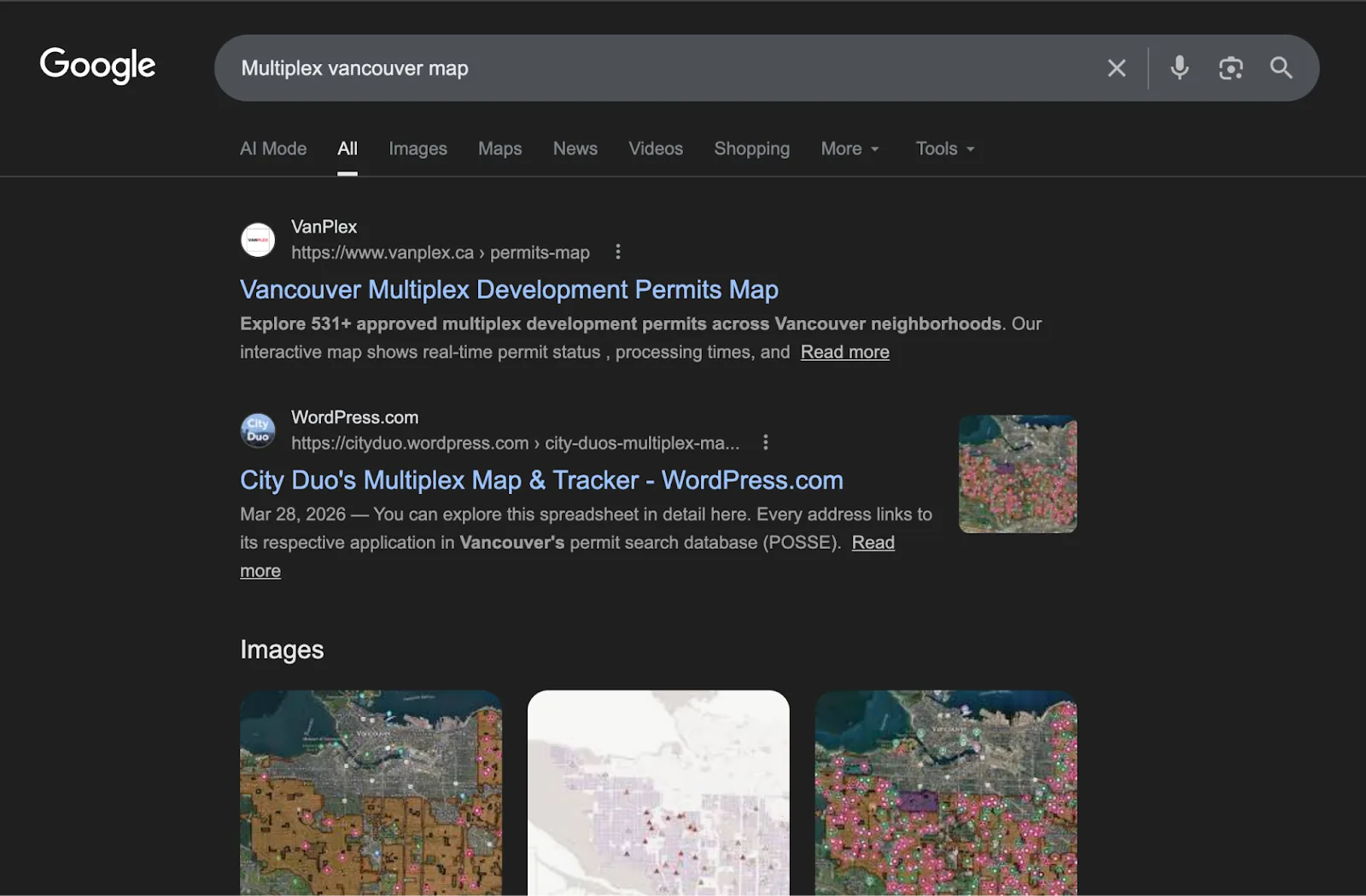
The first result is VanPlex's permits map page. Its address ends in "permits-map", and its title in the screenshot reads "Vancouver Multiplex Development Permits Map". The person who typed those three words wanted a map, and the page is a map.
Google's guide for site owners, called the SEO Starter Guide (SEO is search engine optimization, the work of making a website findable on Google), says: "Creating content that people find compelling and useful will likely influence your website's presence in search results more than any of the other suggestions in this guide." A map of the multiplex permits in a city is useful to a lot owner who wants to see what is being built near the lot.
What is Google's AI Overview, and how does a website become a source in it?
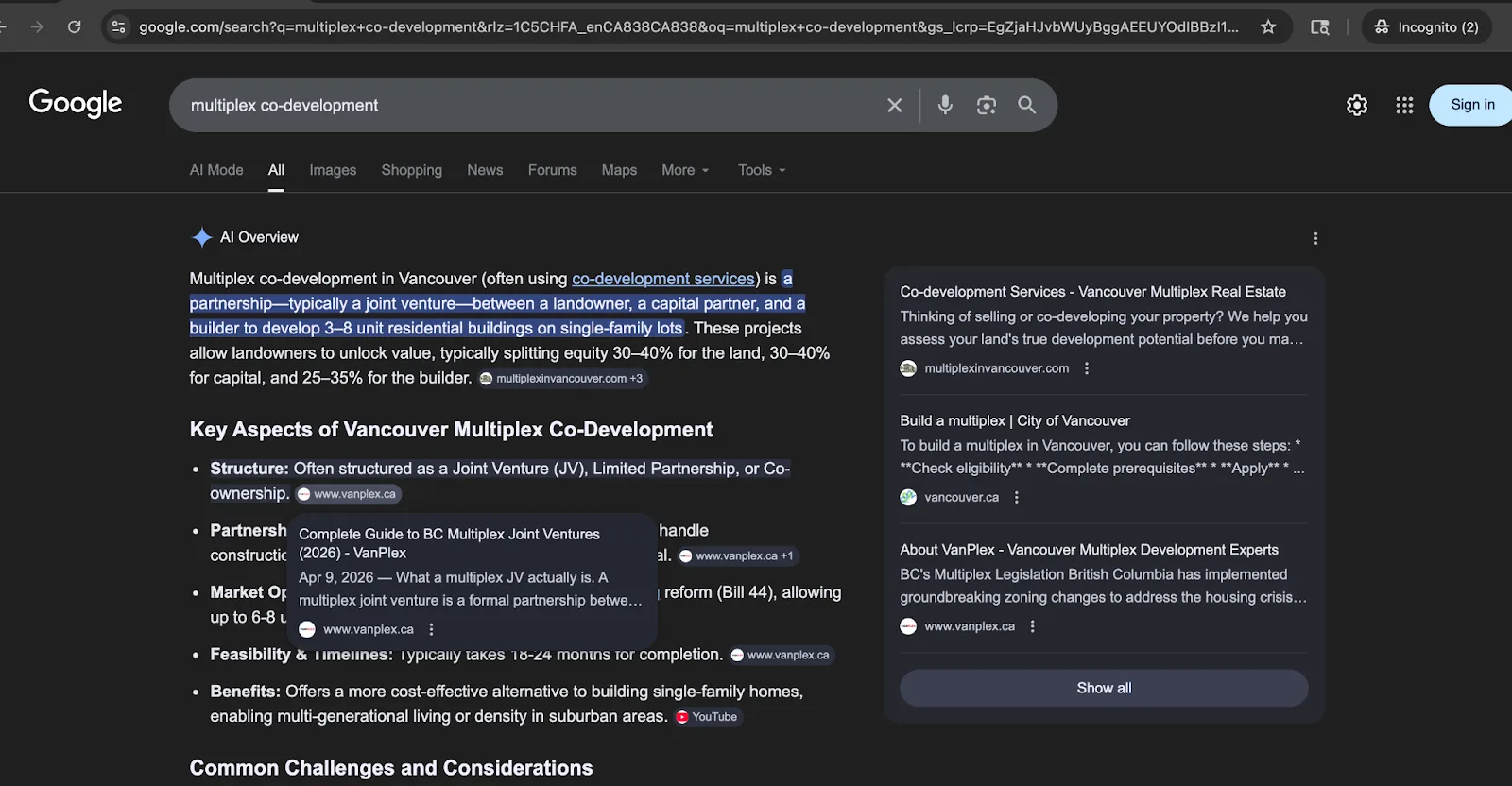
An AI Overview is an answer that Google's AI writes on the results page, with links to the pages that support it. Google says AI Overviews help people understand the main point of a complicated topic or question more quickly, and that they appear only when its systems judge that they add something to the ordinary results.
How does a page qualify? Google's documentation is direct: "To be eligible to be shown as a supporting link in AI Overviews or AI Mode, a page must be indexed and eligible to be shown in Google Search with a snippet". Indexed means stored in Google's record of pages, a snippet is the short description under a result, and AI Mode is another of Google's AI features. Then: "There are no additional technical requirements." Among the practices Google lists as worthwhile are "Making your content easily findable through internal links" (links from one page of your site to another) and "Making sure that important content is available in textual form". The same page states that no special file is required: "You don't need to create new machine readable files, AI text files, or markup to appear in these features."
In the screenshot, the search is "multiplex co-development", which the overview defines as a partnership between a landowner, a capital partner and a builder. The address www.vanplex.ca appears beside three of the points in the answer, and the card that is open names the page: "Complete Guide to BC Multiplex Joint Ventures (2026)", where BC is British Columbia. The card's preview of that page is a definition of the term. The panel on the right lists the sources, and VanPlex's About page is the third, after another real estate website and the City of Vancouver. VanPlex is one source among several, and we say so plainly.
What does Bing's AI Performance report count?
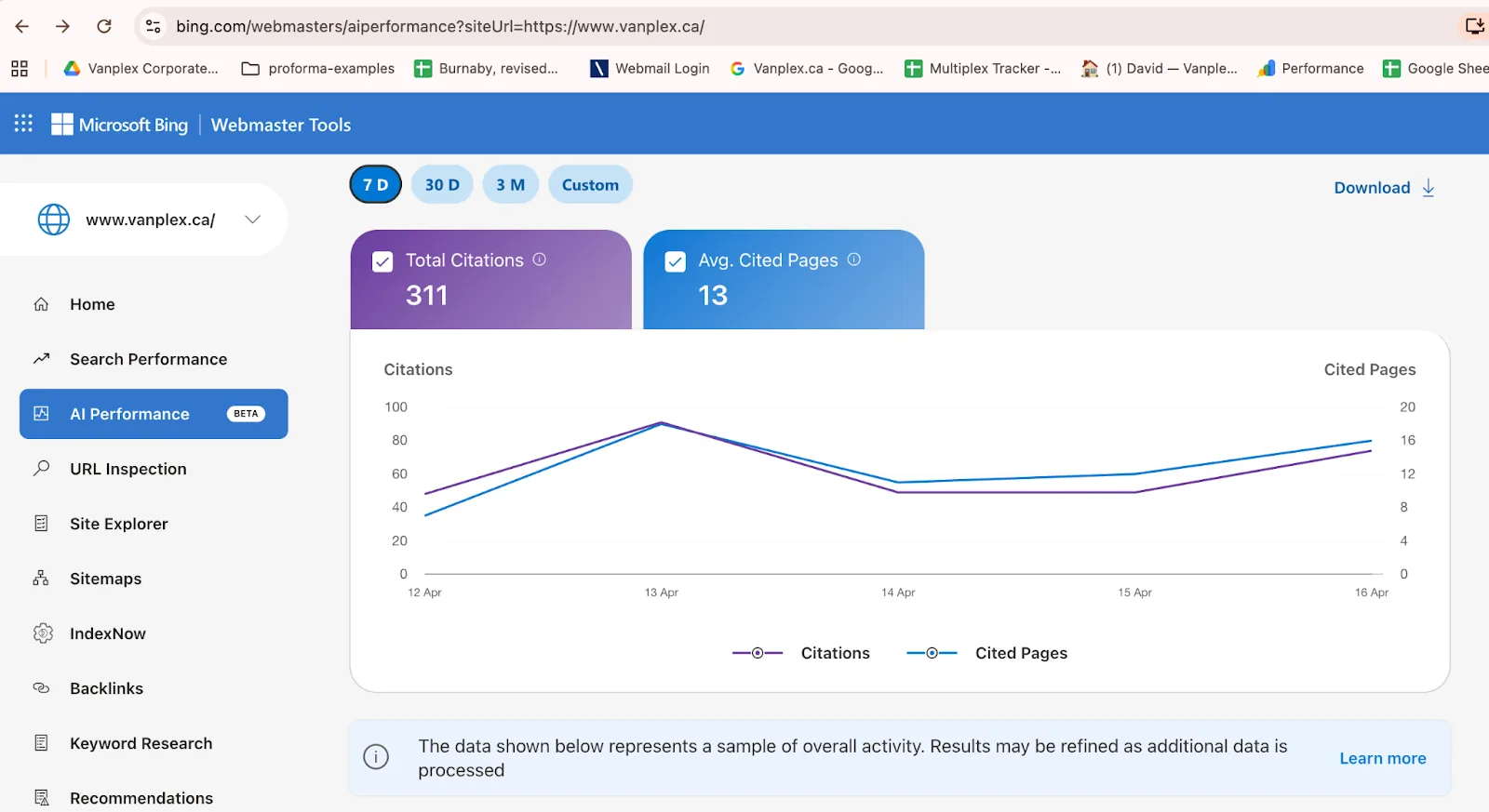
Bing is Microsoft's search engine, and Bing Webmaster Tools is the tool that, in Microsoft's words, helps website owners understand "search performance" there. On February 10, 2026 Microsoft announced a report inside it called AI Performance, which "shows how publisher content appears across Microsoft Copilot, AI-generated summaries in Bing, and select partner integrations".
Microsoft defines the two figures. Total Citations: "Shows the total number of citations that are displayed as sources in AI-generated answers during the selected time frame." Average Cited Pages: "Shows the average number of unique pages from your site that are displayed as sources in AI-generated answers per day over the selected time range."
So the screenshot says this: in the seven-day period selected, pages of vanplex.ca were displayed as sources 311 times in AI-generated answers, and on an average day 13 different pages of the site were displayed. The "7 D" button is selected, and the date labels on the chart run from April 12 to April 16.
Microsoft is careful about what the figures mean, and we follow it. The announcement says that the second figure "does not indicate ranking, authority, or the role of any page within an individual answer". A citation, in this report, is one display of a page as a source. In the same announcement Microsoft recommends clear headings, tables and question-and-answer sections, and adds: "Examples, data, and cited sources help build trust when content is reused in AI-generated answers."
Which kinds of pages earned each result?
Read the four screenshots together, and each result belongs to a different type of page.
| Result | Page that earned it | |---|---| | Featured snippet for "multiplex developer vancouver" | The homepage, which says in plain sentences what the business does and where | | First place for "Multiplex vancouver map" | The permits map page | | Citation in the AI Overview for "multiplex co-development" | A guide to multiplex joint ventures, and the About page | | 311 citations in Bing's AI Performance report | 13 different pages on an average day |
Three of the seven things that our free check looks at, when it grades a website's readiness for AI assistants, are visible here: whether it is clear who the business is and what it does, content that answers specific questions directly, and depth, meaning several pages covering related topics, linked together. Our guide to AI search for home builders explains all seven.
VanPlex is our own test site, so a second record is useful. Rain City Properties (Vancouver real estate, multiplex land) went from page 10 to the number 1 organic result for "sell multiplex land" in 30 days, verified in April 2026; the account is in our Rain City Properties case study.
What does the same work look like for a casita builder in Phoenix?
Begin with the homepage: a few plain sentences that say what you build, in which city, and for whom, because that is the type of text Google took for VanPlex's featured snippet.
Then comes a page of public facts that a lot owner looks for, the counterpart of the permits map, and here Arizona gives a casita builder good material. State law (section 9-461.18 of the Arizona Revised Statutes) applies to municipalities with more than 75,000 people. It requires them to allow, on any lot where a single-family home is allowed, at least one attached and one detached accessory dwelling unit (shortened to ADU: a second small home on the same lot, which is what a casita is). It also requires them to allow an ADU of 75 percent of the home's gross floor area or 1,000 square feet, whichever is less. A page that states these rules, links to the statute and then applies them to a real lot answers a question that lot owners ask.
The third page is a guide that defines one term your clients ask about and answers the questions around it, as VanPlex's joint venture guide does. Our guide to marketing for home builders sets out the full plan.
And for a custom home builder or a small developer in Florida?
The homepage rule is the same. For the page of public facts, Florida offers a different subject: time. Section 553.792 of the Florida Statutes gives a local government 30 business days to approve, approve with conditions, or deny a building permit application for a residential unit of less than 7,500 square feet. The period is counted from a complete and sufficient application, and it applies when the applicant uses the local government's own plans reviewer. A custom home builder who explains this rule in plain words, and adds the experience of the builder's own county, has a page that answers the question "how long does a building permit take?".
On ADUs, Florida's statute leaves the decision to each place: "A local government may adopt an ordinance to allow accessory dwelling units in any area zoned for single-family residential use." A Florida page on ADUs must therefore be written city by city.
And the small developer, who needs lot owners and partners to find the company? Here the VanPlex example is the closest, because the page cited in the AI Overview is a guide to multiplex joint ventures, a subject for lot owners and partners. Our pages on marketing for small developers and search engine optimization for real estate developers give more detail.
To see how your own website stands on these points, run the free Get Found Check. You enter your website address, and in under 60 seconds it returns a letter grade from A to F with a score out of 100, findings in six areas, three to five quick fixes, a comparison with up to four competitors, and a separate grade for readiness for AI assistants. It reads one page, so take the grade as a place to start.
Sources
- Featured snippets and your website, Google Search Central, Last updated 2025-12-10, accessed 29 September 2026.
- AI features and your website, Google Search Central, Last updated 2025-12-10, accessed 29 September 2026.
- SEO Starter Guide: The Basics, Google Search Central, Last updated 2025-12-10, accessed 29 September 2026.
- Introducing AI Performance in Bing Webmaster Tools Public Preview, Microsoft Bing Blogs, February 10, 2026, accessed 29 September 2026.
- Arizona Revised Statutes 9-461.18, Accessory dwelling units; regulation; applicability; definitions, Arizona State Legislature, accessed 29 September 2026.
- Section 553.792, Building permit application to local government, The Florida Legislature, The 2026 Florida Statutes, accessed 29 September 2026.
- Section 163.31771, Accessory dwelling units, The Florida Legislature, The 2026 Florida Statutes, accessed 29 September 2026.
- VanPlex case study and screenshots, Licheo, accessed 29 September 2026.
- Licheo's published description of itself (llms.txt), Licheo, accessed 29 September 2026.