I'm going to be honest with you: when Rain City Properties first reached out, I thought their goals were unrealistic.
They wanted to rank #1 for "sell multiplex land" and related Vancouver multiplex keywords. At the time, they were sitting somewhere around position 94. Page 10. Basically invisible. The keywords they cared about most were dominated by agencies with decades of domain authority, massive link profiles, and marketing budgets that dwarfed theirs.
30 days later, they hit position 1.
Not position 5. Not "first page." Position 1, the first organic result. And they've held it since.
Here's the proof:
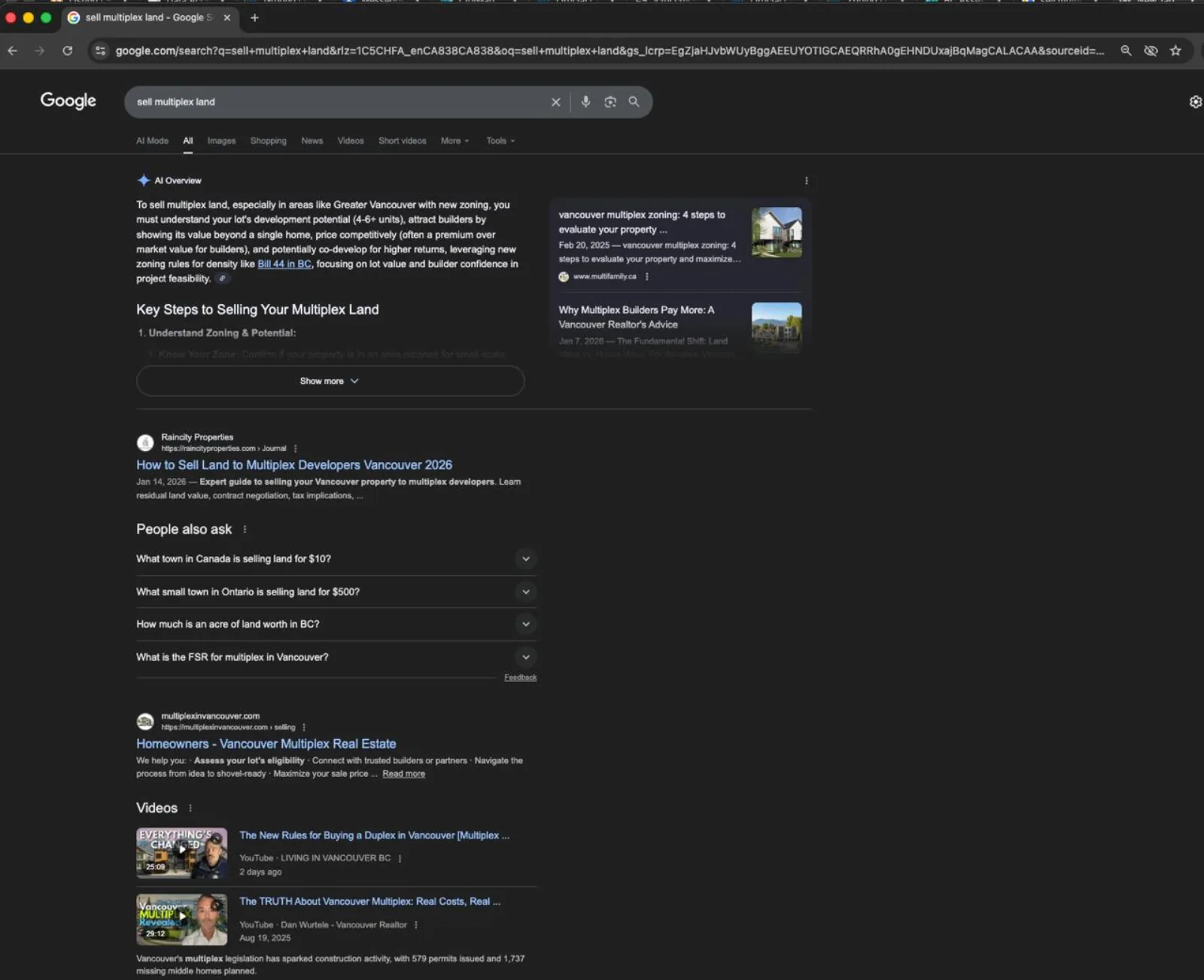
This wasn't the result of some complex 6-month SEO campaign. This was one month of licheo's AI SEO agent running autonomously on their site, analyzing, optimizing, creating content, and building topical authority while Greyden Douglas focused on actually selling properties.
This isn't going to be one of those case studies where I tell you to "create great content" and "build quality backlinks." You've read those. Everyone has. They're useless. Instead, I'm going to walk you through what licheo actually did, why it worked, and what moved the needle most.
The starting point: worse than we expected
Rain City Properties is a Vancouver-based real estate agency with a focus that most realtors don't have: they specialize in multiplex development properties and land assembly. Their lead agent, Greyden Douglas, has 20+ years of experience and a network of 75+ builders who trust him to find the right properties.
Great business. Terrible online visibility.
When licheo ran the initial audit, here's what it found:
The site was built on a template that loaded 47 unused JavaScript files on every page. Time to First Byte was averaging 4.2 seconds. Largest Contentful Paint was over 8 seconds on mobile. Google was basically giving up on crawling most of the site because it took so long to render anything.
Their Google Business Profile hadn't been updated in 18 months. The primary category was set to "Real Estate Agency," accurate but generic. No posts, no Q&A, no product listings, and their service area was set to all of British Columbia when 95% of their business comes from Metro Vancouver.
Internal linking was essentially non-existent. They had neighborhood pages for 40+ Vancouver communities, but none of them linked to each other or to the main service pages in any strategic way. Google couldn't understand the relationship between their content.
And schema markup? They had basic Organization schema on the homepage. That was it. No LocalBusiness, no RealEstateAgent, no Service schema, no FAQ schema. Nothing that would help Google understand what they actually do or where they do it.
Oh, and their most important keyword, "sell multiplex land," appeared exactly zero times on their website. Not in a title tag. Not in an H1. Nowhere.
What licheo did in the first week
The AI agent started with a comprehensive audit: 55 different checks across technical SEO, content quality, local signals, and competitive positioning. Within hours, it had identified 847 issues. But here's where AI differs from traditional SEO tools: licheo doesn't just list problems. It prioritizes them by actual impact and starts fixing what matters.
First priority was Core Web Vitals. The agent identified the 41 unused JavaScript files and recommended their removal. It flagged the hosting bottleneck and suggested CDN implementation. It found lazy-loading opportunities and generated the exact code changes needed.
Within the first week, TTFB dropped from 4.2 seconds to 0.3 seconds. LCP went from 8+ seconds to 1.4 seconds on mobile. The site went from failing Core Web Vitals to passing all metrics.
The agent also cleaned up the crawl structure automatically. It generated a proper XML sitemap prioritizing high-value pages. It identified 180 broken internal links and provided the redirect map. It found duplicate content across neighborhood pages and recommended canonical tags.
One thing that made a huge difference: the URL structure fix. The site had URLs like /properties/vancouver-west-side-homes-for-sale-kitsilano-area/. The agent recommended changing to /neighborhoods/kitsilano/. Clean. Descriptive. Keyword-relevant without being stuffed.
Week 2-3: Building topical authority at machine speed
Here's where it gets interesting.
Rain City already had a free multiplex calculator on their site, a tool that lets homeowners check if their property qualifies for multiplex development under Vancouver's new zoning rules. It was getting maybe 50 visits a month. Buried in the navigation. No internal links pointing to it.
licheo identified this as a massive opportunity. The agent analyzed search intent for multiplex-related queries in Vancouver and mapped out an entire content cluster, not as a vague recommendation, but as specific pages with target keywords, suggested word counts, and outline structures.
The AI then generated the first draft content. A comprehensive guide to Vancouver multiplex zoning at 4,500 words. Not keyword-stuffed garbage. Actual useful information about lot sizes, setbacks, FSR calculations, the approval process, typical costs, and expected timelines. The kind of content that answers every question someone might have before they call a realtor.
Greyden reviewed and approved the content. licheo published and optimized it.
Then the agent built supporting content. A page specifically targeting "Can I build a multiplex on my lot?" A comparison of duplex vs triplex vs fourplex ROI in different Vancouver neighborhoods. A breakdown of BC Housing's multiplex funding programs that nobody else had bothered to write about.
Each piece linked strategically to the others and to the main multiplex services page. The agent was building a topical cluster that demonstrated undeniable expertise in this specific niche, and doing so automatically.
Within three weeks, that content cluster was generating 400+ visits per month. The multiplex calculator, now properly positioned, was capturing 35-40 leads monthly. Up from essentially zero.
The schema implementation that changed everything
I need to talk about schema markup because I think it was one of the highest-impact changes licheo made, and most people get it completely wrong.
Rain City's old site had basic Organization schema. That's like bringing a business card to a job interview: technically correct but not impressive.
Here's what licheo implemented automatically:
LocalBusiness schema with detailed information about their service area, operating hours, contact methods, and payment options. This alone helps Google understand that they're a local business serving a specific geographic area.
RealEstateAgent schema (yes, this exists) with propertyType specifications indicating they handle residential and multi-family properties. Added areaServed with GeoCircle definitions for each neighborhood they cover.
Service schema for each of their core offerings: multiplex consulting, land assembly, buyer representation, seller representation. Each service links to the main LocalBusiness entity using @id references.
FAQPage schema on every page that had Q&A content. This doesn't produce a Google rich result anymore (that feature was retired in May 2026), but it helps Google understand the informational nature of the content and increases the chances of appearing in featured snippets and AI Overviews.
HowTo schema on procedural content like the multiplex development process guide. It no longer produces a Google rich result either, that was dropped back in 2023, but AI Overviews and other AI systems still parse it as a signal for step-by-step content.
The difference was noticeable within weeks. Their search appearance became richer: more details in the listings, better click-through rates even for positions that hadn't changed yet.
And look at that screenshot again. Rain City isn't just on the first page; they're the #1 organic result for a high-intent commercial query. That's schema markup plus topical authority plus fresh, well-structured content working together.
Local SEO: owning the map pack
Local SEO for real estate is brutally competitive. Every agent in Vancouver is fighting for the same map pack spots. Most of them are doing the bare minimum: claiming their profile, adding some photos, hoping for reviews.
licheo went considerably further.
First, the Google Business Profile got a complete overhaul. Changed the primary category to "Real Estate Consultant" which is more specific than "Real Estate Agency" and had less competition. Added "Residential Real Estate Developer" and "Land Planning Service" as secondary categories. Updated the service area to focus specifically on Metro Vancouver neighborhoods where they actually operate.
Then the agent built out the services section properly. Instead of generic "buying" and "selling," it added specific services: "Multiplex Development Consulting," "Land Assembly Services," "Builder Property Matching," "Investment Property Analysis." Each with descriptions that included relevant keywords naturally.
The posts feature on GBP is criminally underutilized by most businesses. licheo started generating weekly updates: market insights, neighborhood spotlights, zoning news. Not promotional garbage, but genuinely useful local content. Google rewards businesses that actively engage with their profiles.
Reviews were already solid at 5.0 stars with 47 reviews, but licheo recommended a systematic follow-up process to capture more. Within the month, they were at 58 reviews. Volume plus recency plus high ratings equals better local rankings.
The local pack results came faster than the organic results. Within three weeks, Rain City was appearing in the map pack for "multiplex realtor Vancouver" and "Vancouver development property realtor."
Answering questions nobody else would
Here's something licheo does exceptionally well: finding the questions that seem too specific or too complicated for anyone to bother answering.
The agent identified dozens of these for multiplex development in Vancouver.
"How much does it cost to convert a house to a duplex in Vancouver?" No good content existed. licheo drafted 2,000 words breaking down actual costs: permits, construction, professional fees, soft costs, contingencies. Greyden added real numbers from his builder network.
"What's the FSR for my property in Vancouver?" Complicated question because it depends on zoning, lot size, and recent policy changes. The agent built an interactive guide that walked people through finding their specific FSR allowance.
"Can I build a fourplex on RS-1 land in Vancouver?" Topical question because of the new provincial zoning legislation. licheo published a detailed explainer within days of identifying the search opportunity, when competitors were still trying to understand the policy.
Each of these pages targeted long-tail keywords with real search volume. Individually, they might only bring in 50-100 visits per month. But collectively, they established Rain City as the definitive resource for multiplex development questions in Vancouver.
And here's the thing about long-tail content: it converts way better than head terms. Someone searching "Vancouver realtor" could be looking for anything. Someone searching "how much does it cost to convert a house to a duplex in Vancouver" is seriously considering a project and needs professional help.
The results: 30 days with licheo
Look at the screenshot at the top of this article again. That's real. That's what happens when you search "sell multiplex land" on Google right now.
Rain City Properties is:
- Ranking #1 in organic results for "sell multiplex land"
- Appearing above competitors who have been in this market for decades
- Surfacing across a whole family of related Vancouver property searches
30 days ago, they were on page 10. Now they own the search results for their most valuable keyword.
Holding the #1 organic spot for a query this commercial is particularly significant. When someone in Vancouver searches for exactly the service Rain City provides, their content is the first thing Google shows. That's being recognized as an authoritative source.
All of this while Greyden focused on what he does best: closing deals.
Why this matters for your business
Look, I know what you're thinking. "That's great for a realtor in Vancouver, but my business is different."
Maybe. But the principles apply universally.
Technical foundation matters. If your site is slow, if Google can't crawl it properly, if your structure is a mess, nothing else you do will work as well as it should. licheo identifies and fixes these issues automatically.
Topical authority beats domain authority for specific queries. You don't need to outrank massive competitors on everything. You need to own your niche so thoroughly that Google has no choice but to rank you for the queries that matter most to your business. licheo builds this authority through strategic content clustering.
Local SEO is still underutilized. Most businesses set up their Google Business Profile once and forget it. The ones who actively maintain and optimize it get disproportionate returns. licheo manages this continuously.
And the biggest thing: answer the questions nobody else is willing to answer. The complicated ones. The specific ones. The ones that require actual expertise to address properly. That's where the real opportunities are. licheo finds these gaps and fills them.
Rain City Properties wasn't doing anything revolutionary. They weren't running complex link-building campaigns or gaming the algorithm. They let licheo handle the fundamentals (technical optimization, content creation, local SEO, schema markup) while they focused on their actual business.
The gap between page 10 and page 1 is smaller than you think. It just requires consistent, intelligent optimization that most businesses don't have time to do manually.
That's what licheo is for.
If you want to see what's possible for your own site, check your SEO standing for free and see where you stand.