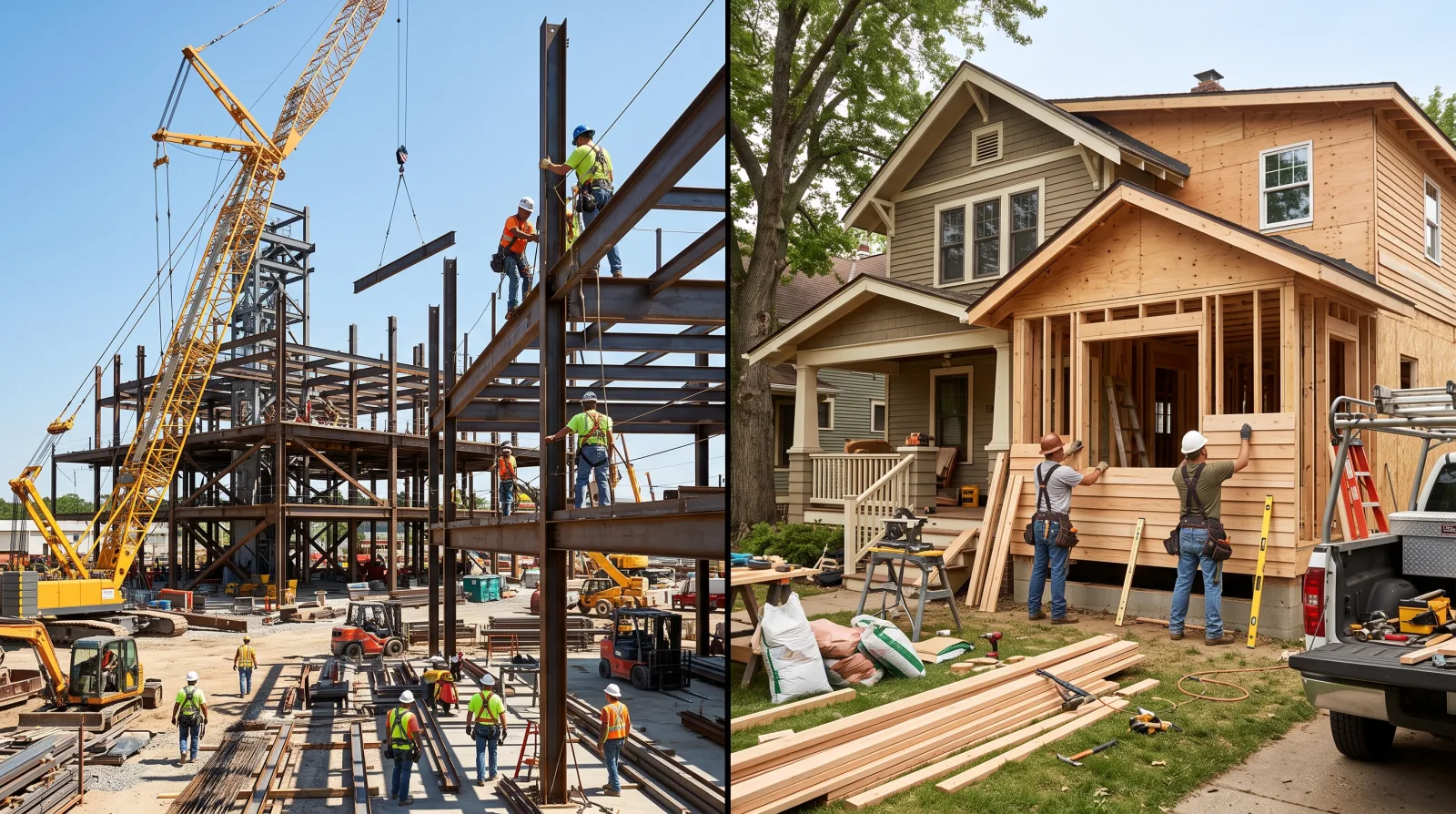
On January 1, 2026, the owner of a single-family lot within one mile of Tempe's central business district gained a new right: to build a duplex, a triplex, a fourplex or townhouses on that lot, with no rezoning and no use permit. State law required every Arizona city of 75,000 people or more to allow these homes near its downtown by that date. A right of this kind brings questions, naturally. Can I put four homes on my lot? And who builds these?
A lot owner types these questions into Google or asks an AI assistant such as ChatGPT. The builder whose website answers them for a named city, with that city's real rules, has given the search engine and the assistant a page to show. One caution before we commence: this is marketing guidance, and ordinances change, so read the city's current code before you quote a rule to a client.
What does Arizona's middle housing law require?
The law began as House Bill 2721, which the Governor approved on May 21, 2024 (Laws 2024, Chapter 197). It is now section 9-462.13 of the Arizona Revised Statutes, written A.R.S. 9-462.13, and it applies to a municipality with a population of 75,000 persons or more.
On or before January 1, 2026, each of those municipalities had to allow duplexes, triplexes, fourplexes and townhomes (the statute calls the group middle housing) as a permitted use in two places. The first is every lot zoned for single-family residential use within one mile of the municipality's central business district. The second is at least 20 percent of any new development of more than ten contiguous acres. The statute defines a permitted use as approval without a public hearing, a variance, a conditional use permit, a special permit or a special exception.
For a city that missed the date, the statute says middle housing "shall be allowed on all lots in the municipality zoned for single-family residential use without any limitations." Land near a public or military airport and areas without water and sewer service are among the exclusions.
What is a city forbidden to ask of a duplex or a fourplex?
Under subsection B, a city may not restrict middle housing to less than two floors, or hold the floor area ratio (the building's total floor area compared with the area of the lot) under 50 percent. It may not apply stricter rules or review processes than it applies to single-family homes in the same zone. It may not require that the owner live on the property. It may not require a commercial building code, a fire sprinkler, or more than one off-street parking space per unit.
One 2026 bill, HB 2375, would exempt historic districts from the middle housing requirement. The House passed it on March 18, 2026 by 31 votes to 24, and the last action on record is a second reading in the Senate on March 25, 2026. We found no enacted version, and the statute as read on September 29, 2026 contains no exclusion for historic districts.
What did Phoenix, Tucson, Mesa, Scottsdale, Chandler and Tempe adopt?
The table gives what each city's own documents say.
| City | Ordinance | Council date | Where it applies | Parking | Height, floor area or coverage | |---|---|---|---|---|---| | Phoenix | G-7446 (text) and G-7447 (map) | G-7447 was on the agenda of November 19, 2025; the city record shows G-7446 as "Adopted" | A mapped area within one mile of Downtown, and up to 20% of lots in a new subdivision of 10 contiguous acres or more | One space per primary dwelling unit (August 2025 staff draft) | Absent from the documents we read | | Tucson | No. 12219 | December 16, 2025 (6 to 1) | Citywide "except in rural residential areas" | Set by the code's parking table; it may be met with on-street parking, or waived near a bikeway or a public transit route | In the R-1 zone: four homes on a lot of 6,000 square feet, 25 feet maximum height | | Mesa | No. 5989 | December 8, 2025 (unanimous) | Single-residence lots within one mile of the Downtown Area, and no more than 20% of a new single-residence development over 10 acres | No more than one space required per unit | Building coverage up to 50% of the lot | | Scottsdale | 4690 | November 17, 2025 | Single-family lots within one mile of the Old Town Area, and a limited part of a new residential development over 10 acres | At least one off-street space per unit | Two stories maximum; 0.5 cumulative floor area ratio | | Chandler | No. 5141 | November 13, 2025 (7 to 0) | All single-family lots within one mile of the Central Business District, and at least 20% of any new development of more than ten contiguous acres | One covered off-street space per unit | 25 feet at the setback line, rising at a 45-degree slope to 35 feet; gross building area up to 50% of lot area | | Tempe | O2025.45 | November 6, 2025 | Single-family lots at least partly within a one-mile radius of the central business district, and up to 20% of net site area in a new development over 10 contiguous net acres | One space per unit on site | District height, with no limit below two floors; 50% maximum lot coverage |
The Phoenix parking figure comes from a staff report dated August 2025, a draft the council could change before adoption; we did not read the adopted text of Ordinance G-7446. The Chandler standards come from an unsigned copy of the ordinance posted by the city. For Tucson, the date, the vote and the scope come from the city's news release, and the standards from the signed copy of Ordinance No. 12219; the city says the change applies from January 1, 2026.
Tucson added cottage courts to the list. Phoenix mapped an area the council report measures at 4,467.45 acres, which excludes the land near Phoenix Sky Harbor Airport, and its rule "allows 4 primary dwelling units per lot". In Mesa, eight historic districts lie inside the one-mile area, and middle housing there must also follow the historic overlay procedures. In Tempe, townhouses built under this rule cannot add an accessory dwelling unit (shortened to ADU: a second small home on the same lot).
How many buildings of two to four units did Arizona permit before the law applied?
The U.S. Census Bureau's Building Permits Survey counts permits by the size of the building. Its annual files for 2024 and 2025 describe the two years before the law applied. The Bureau calls the figures estimates with imputation: where a place sent no report, the Bureau fills in a calculated figure. Tucson and Tempe reported in 0 months of both years, so their city figures are imputations.
| Area (buildings, with homes in parentheses) | Two-unit, 2024 | Two-unit, 2025 | Three to four units, 2024 | Three to four units, 2025 | |---|---|---|---|---| | Arizona | 927 (1,854) | 589 (1,178) | 84 (300) | 79 (292) | | Phoenix-Mesa-Chandler metro area | 757 (1,514) | 483 (966) | 72 (258) | 49 (178) | | Tucson metro area | 40 (80) | 24 (48) | 7 (24) | 0 (0) | | City of Phoenix | 470 | 354 | 4 | 8 | | City of Mesa | 2 | 1 | 6 | 3 | | City of Scottsdale | 0 | 6 | 0 | 20 | | City of Chandler | 5 | 1 | 16 | 6 | | City of Tucson (imputed) | 21 | 16 | 0 | 0 | | City of Tempe (imputed) | 7 | 7 | 0 | 0 |
The city of Phoenix issued permits for 354 two-unit buildings in 2025, which is 73 percent of the 483 in the Phoenix metro area. Elsewhere the counts are small: Mesa recorded 4 buildings of two to four units in all of 2025, and Chandler recorded 7. A completed duplex or fourplex in those cities is an uncommon project, and the website should say so with the numbers.
Where do buyers look first?
The National Association of REALTORS asked people who bought a home between July 2023 and June 2024 how they searched. As a first step, 43 percent looked online for properties, and 1 percent contacted a builder or visited builder models. Asked where they found the home they bought, 51 percent said the internet and 5 percent said a home builder or the builder's agent. The survey is national and describes home buyers, so apply it to Arizona lot owners with care.
What should a builder's website say, city by city?
Google's starter guide for site owners gives the principle: "Think about the words that a user might search for to find a piece of your content." A lot owner's words include a city: "fourplex builder Phoenix", "can I build a duplex on my lot in Tempe", "how tall can a fourplex be in Chandler". So publish one page for each city you serve, and on it the rules of that city: the ordinance number and date, the area where middle housing is allowed, the parking requirement, and the height or coverage limit. Write each question as a heading, with the answer directly beneath it in one or two plain sentences. The same guide says a good title "is unique to the page, clear and concise, and accurately describes the contents of the page": "Duplex and fourplex builder in Mesa", for example.
When we read 80 small builder websites in Arizona and Florida on September 29, 2026, we found 5 with no page for any city or area served linked from the homepage, and 12 whose homepage title or main heading named no service or no city. We wrote one note per site and kept it only when a second reading confirmed it, so each count is a minimum. Our guides to service area pages and to ADU and middle housing pages describe the structure.
Why must each city page state that city's own rules?
A builder who serves six cities could write one page and change the city name six times. Google's spam policies define a practice they call doorway abuse as the case "when sites or pages are created to rank for specific, similar search queries", with pages that "lead users to intermediate pages that aren't as useful as the final destination". One of Google's examples is a set of pages aimed at specific regions or cities that all send the visitor on to one page.
The table above is the answer: the rules differ from city to city. A Chandler page states 25 feet at the setback line rising to 35 feet, and one covered parking space per unit. A Scottsdale page states two stories and a 0.5 floor area ratio. Pages built on facts like these differ from each other, and each one is useful to the person who arrives on it. The starter guide also asks site owners to "Check in on previously published content and update it as needed", and HB 2375 demonstrates why: if it becomes law, every page that mentions a historic district will need a new paragraph.
What else should the site show, and do AI assistants read it?
Publish one page for each completed duplex, triplex, fourplex or townhome project, with the city, the lot size, the number of homes and the ordinance under which it was permitted. A small developer has a second audience, the lot owner who wants to sell or to build together, and our guide for small developers covers the pages for that reader. The casita option, under a separate state law, is described in casita and ADU rules in six Arizona cities.
And the AI assistants? Google states that "There are no additional requirements to appear in AI Overviews or AI Mode", two AI features of Google Search, and its list of good practices includes "Making sure that important content is available in textual form". OpenAI's documentation says a program named OAI-SearchBot reads websites so that they can be shown in ChatGPT's search answers. In both cases the practical step is the same: write the city's rules as ordinary text on the page, and let these reading programs in.
Licheo does the website, search and AI work that big companies pay whole teams for, for small businesses, at one flat monthly fee, month to month, with no contract (contact us for pricing). Our home builder marketing guide and our page on search visibility for home builders explain the work. To see how findable your own site is, run the free Get Found Check: you enter your website address, and in under 60 seconds it returns a letter grade from A to F with a score out of 100. It reads one page, so treat the grade as a place to start.
Sources
- Chapter 0197, 562R, S Ver of HB2721, Arizona State Legislature, approved May 21, 2024, accessed 29 September 2026.
- A.R.S. 9-462.13, Zoning; development; middle housing; applicability; definitions, Arizona State Legislature, accessed 29 September 2026.
- HB 2375: housing; zoning; historic neighborhoods, Arizona House of Representatives Majority Research Staff, accessed 29 September 2026.
- HB 2375 action history, FastDemocracy (a bill tracker, used for dates only), accessed 29 September 2026.
- Middle Housing Text Amendment and Overlay District, City of Phoenix, accessed 29 September 2026.
- File 25-2234, Ordinance G-7446, City of Phoenix Legistar, accessed 29 September 2026.
- City Council Formal Meeting Report, Agenda Date: 11/19/2025, Item No. 72, City of Phoenix, November 19, 2025, accessed 29 September 2026.
- Staff Report Zoning Ordinance Text Amendment Z-TA-1-25-Y and Z-3-25-4-7-8, City of Phoenix, August 29, 2025, accessed 29 September 2026.
- Tucson Expands Housing Options with Middle Housing Code Amendment Approval, City of Tucson PDSD News, December 17, 2025, accessed 29 September 2026.
- Ordinance No. 12219 (Middle Housing), signed copy, City of Tucson, adopted December 16, 2025, accessed 29 September 2026.
- Ordinance No. 5989, City of Mesa, December 8, 2025, accessed 29 September 2026.
- Office of the City Clerk, Council Minutes, December 8, 2025, City of Mesa, accessed 29 September 2026.
- Council Report, File 25-1006, City of Mesa, accessed 29 September 2026.
- Middle Housing, City of Scottsdale, accessed 29 September 2026.
- Meeting Minutes, City Council Regular Meeting, November 13, 2025, City of Chandler, accessed 29 September 2026.
- Ordinance No. 5141, City of Chandler, accessed 29 September 2026.
- Chapter 8, Middle Housing Overlay District, Tempe Zoning and Development Code, Municode, adopted November 6, 2025, accessed 29 September 2026.
- Building Permits Survey, annual files: state 2024 and 2025; metro area 2024 and 2025; West Region places 2024 and 2025, U.S. Census Bureau, 2025 files last modified May 14, 2026, accessed 29 September 2026.
- 2025 Home Buyers and Sellers Generational Trends Report, National Association of REALTORS Research Group, accessed 29 September 2026.
- Search Engine Optimization (SEO) Starter Guide, Google Search Central, last updated 2025-12-10, accessed 29 September 2026.
- Spam policies for Google web search, Google Search Central, last updated 2026-08-28, accessed 29 September 2026.
- AI features and your website, Google Search Central, last updated 2025-12-10, accessed 29 September 2026.
- Overview of OpenAI Crawlers, OpenAI, accessed 29 September 2026.