Let me tell you something that happens every single day. Somebody opens ChatGPT, or Perplexity, or Google, and types something like "how do I check my website ranking" or "what is my SEO score." They get a list of tools. They pick one, run their site through it, and receive a number. Let's say it is 43 out of 100. Or perhaps a letter grade, a C, a D, maybe even an F.
And then they sit there, staring at that number, and they have absolutely no idea what it means.
Is 43 terrible? Is it average? Should they panic? Should they hire someone? Should they redesign the entire site? The number itself tells them almost nothing, because without context (without understanding what was measured, why it matters, and what specifically is dragging the score down) a website score is just a number that makes you feel bad.
I want to change that. Because the truth is, a properly calculated website score is one of the most useful diagnostic tools available to a business owner. It is the equivalent of a blood test at the doctor's office. The number alone is not the diagnosis, but it tells you exactly where to look, and (this is the important part) it tells you what is urgent and what can wait.
Why people search for their website score
The motivation is almost always the same, and it comes in one of three flavors.
The first is curiosity mixed with anxiety. Business owners feel, in their bones, that their website is not performing well. Maybe they notice that competitors appear above them in search results. Maybe a client mentioned they had trouble finding the site. Maybe they just built the thing three years ago and have not touched it since, and somewhere in the back of their mind they know that the internet has moved on without them.
The second is a triggering event. Someone told them their site was slow. A marketing agency sent a cold email saying their SEO was "critically broken" (these agencies, it must be said, send that email to everyone regardless of whether it is true). Or they read an article about AI search engines like ChatGPT and Perplexity now answering questions that used to drive traffic to websites, and they want to know if their site is even visible in this new landscape.
The third, and this one is increasingly common in 2026, is that they heard the term GEO (Generative Engine Optimization) and they want to understand whether their website is optimized not just for Google, but for the AI systems that are rapidly becoming how people discover businesses.
Whatever the motivation, the destination is the same: they want a number, a grade, some kind of objective measurement that tells them where they stand.
What a website score actually measures
Here is where most tools fail their users. They give you a number but they do not explain the methodology. A score of 72 from one tool and a score of 45 from another tool might be measuring completely different things, and both could be accurate within their own framework.
At licheo, when we analyze a website, we examine over fifty distinct factors across ten categories. Let me walk through what actually gets measured, because understanding the ingredients is the only way to understand the recipe.
Technical foundation
This is the infrastructure of your website, the things that happen before a human even sees your content. Does the site use HTTPS? Is there a valid SSL certificate? Does the server respond quickly? Is there a sitemap that tells search engines what pages exist? Is there a robots.txt file that provides crawling instructions?
These might sound mundane, but they are fundamental. A website without HTTPS is flagged by every modern browser as "not secure." A site without a sitemap is asking search engines to guess which pages matter. These are not optimization details. They are prerequisites.
On-page SEO
This is the classic territory of search engine optimization. Do your pages have proper title tags? Are meta descriptions written and unique for each page? Do you use heading tags (H1, H2, H3) in a logical hierarchy? Are images tagged with descriptive alt text?
One might think these basics would be universally handled by now, but the reality is that the majority of small business websites we analyze still have significant gaps here. Missing meta descriptions, duplicate title tags across multiple pages, images with no alt text whatsoever. These are not difficult to fix, but they are remarkably easy to overlook.
Content quality and depth
Search engines, both traditional and AI-powered, favor content that demonstrates genuine expertise. How much substantive content does your site have? Is it original? Does it answer the questions your potential customers are actually asking?
This is where the difference between a score of 40 and a score of 85 often lives. A website with five thin pages that each say some variation of "we are the best, contact us" will score dramatically lower than a site with detailed service descriptions, helpful blog articles, case studies, and FAQ sections that address real customer concerns.
AI search readiness (GEO factors)
This is the new frontier, and it is precisely why a 2024-era SEO score is no longer sufficient. AI search engines like ChatGPT, Perplexity, Google's AI Overviews, and Claude do not just crawl your website; they try to understand it. They look for structured data, clear entity relationships, authoritative content signals, and machine-readable formats that make it easy to extract and cite your information.
A website can score well on traditional SEO and still be nearly invisible to AI search engines if it lacks schema markup, if its content is not structured in a way that AI systems can parse, or if it does not provide the kind of clear, factual, citeable statements that these systems look for when generating answers.
Performance and mobile experience
Page speed matters more than ever, and not just for user experience. Google has used page speed as a ranking factor for years, and AI systems tend to favor sites that load quickly and render well on mobile devices. A site that takes six seconds to load on a phone is not just losing impatient visitors; it is signaling to every search system that it is not well-maintained.
Security and trust signals
SSL certificates, security headers, proper cookie handling, and privacy policy presence all contribute to the overall trust profile of your website. They matter both for direct ranking signals and for the general impression of professionalism that AI systems evaluate when deciding which sources to cite.
What the grades actually mean
When you run a website through our analysis tool, you receive a score out of 100 and a corresponding letter grade. Here is what those grades genuinely indicate:
A (90-100): Exceptional. Your website is technically sound, well-optimized for both traditional search and AI discovery, and demonstrates the kind of quality that search engines actively want to surface. Very few websites score here without deliberate, ongoing optimization work. When we ran licheo.com through our own analysis, it scored 95 out of 100, and the summary noted that it is "an expertly engineered site that practices what it preaches, showcasing exceptional SEO and readiness for AI search."
B (75-89): Strong foundation with room for improvement. The fundamentals are solid. There may be gaps in content depth, some missing structured data, or performance issues that are holding the score back. These sites are competitive but are leaving opportunities on the table.
C (50-74): Average, which in practice means falling behind. The site functions, but it has significant optimization gaps. In a landscape where competitors are actively investing in SEO and GEO, average means you are losing ground every month. Most small business websites we analyze fall in this range.
D (25-49): Serious issues. Multiple critical problems are preventing the site from performing. This could be missing SSL, major mobile usability problems, thin or duplicate content, no structured data, slow loading times, or a combination of these. The site is likely invisible for many relevant searches.
F (0-24): Critical failures. The website has fundamental problems that make it essentially non-functional from a search perspective. We recently analyzed a site, greenfinancialoline.com, that scored 19 out of 100. The analysis revealed that "your website is currently invisible to customers on Google and you cannot receive any business emails at your domain." The site was running WordPress on shared hosting with no analytics, no email configuration, and no discoverability whatsoever. These are not optimization problems. These are existential ones.
The difference between an F and an A: a real comparison
To make this concrete, let me show you two real analyses side by side. These are actual results from our analysis tool, not mockups, not hypotheticals.
greenfinancialoline.com: Score 19/100 (Grade: F)
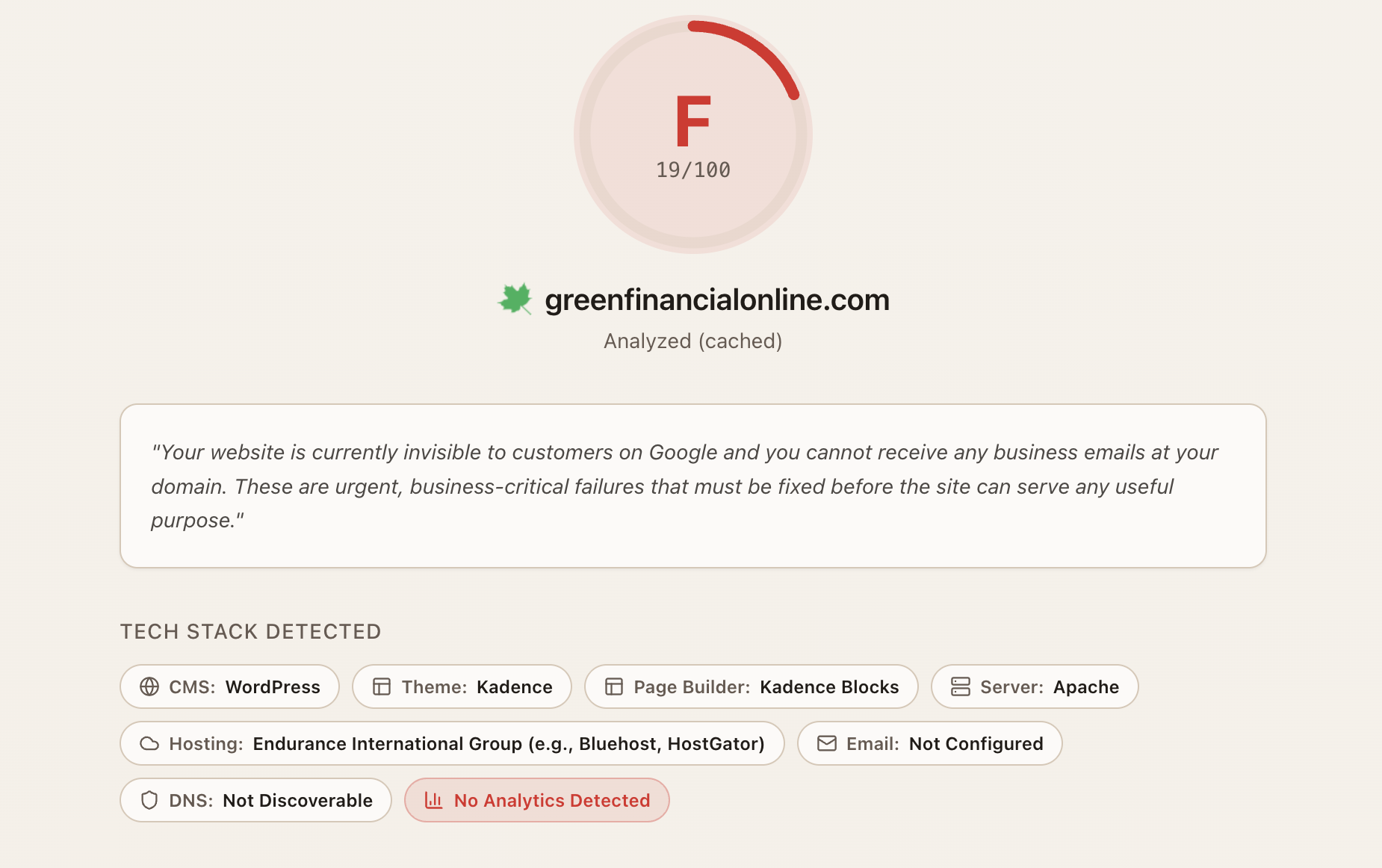
Look at what the analysis reveals. The score circle is almost entirely empty: 19 out of 100, a grade of F. But the real story is in the details below it.
The AI summary is devastating in its clarity: "Your website is currently invisible to customers on Google and you cannot receive any business emails at your domain. These are urgent, business-critical failures that must be fixed before the site can serve any useful purpose."
Then look at the tech stack detection. The system identified WordPress with a Kadence theme and Kadence Blocks page builder, nothing wrong with that stack in principle. But the hosting is Endurance International Group (the company behind Bluehost, HostGator, and other budget hosts), the server is Apache, and here is where it gets truly concerning: email is "Not Configured," DNS is "Not Discoverable," and there is a red warning flag for "No Analytics Detected."
What does this mean in plain language? This business has a website that no one can find through search, cannot receive professional email at their domain, and has no way of even knowing whether anyone visits the site because there is no analytics tracking. The owner is paying for hosting every month, probably $15 to $30, for a website that is functionally equivalent to a billboard in a locked closet.
licheo.com: Score 95/100 (Grade: A)
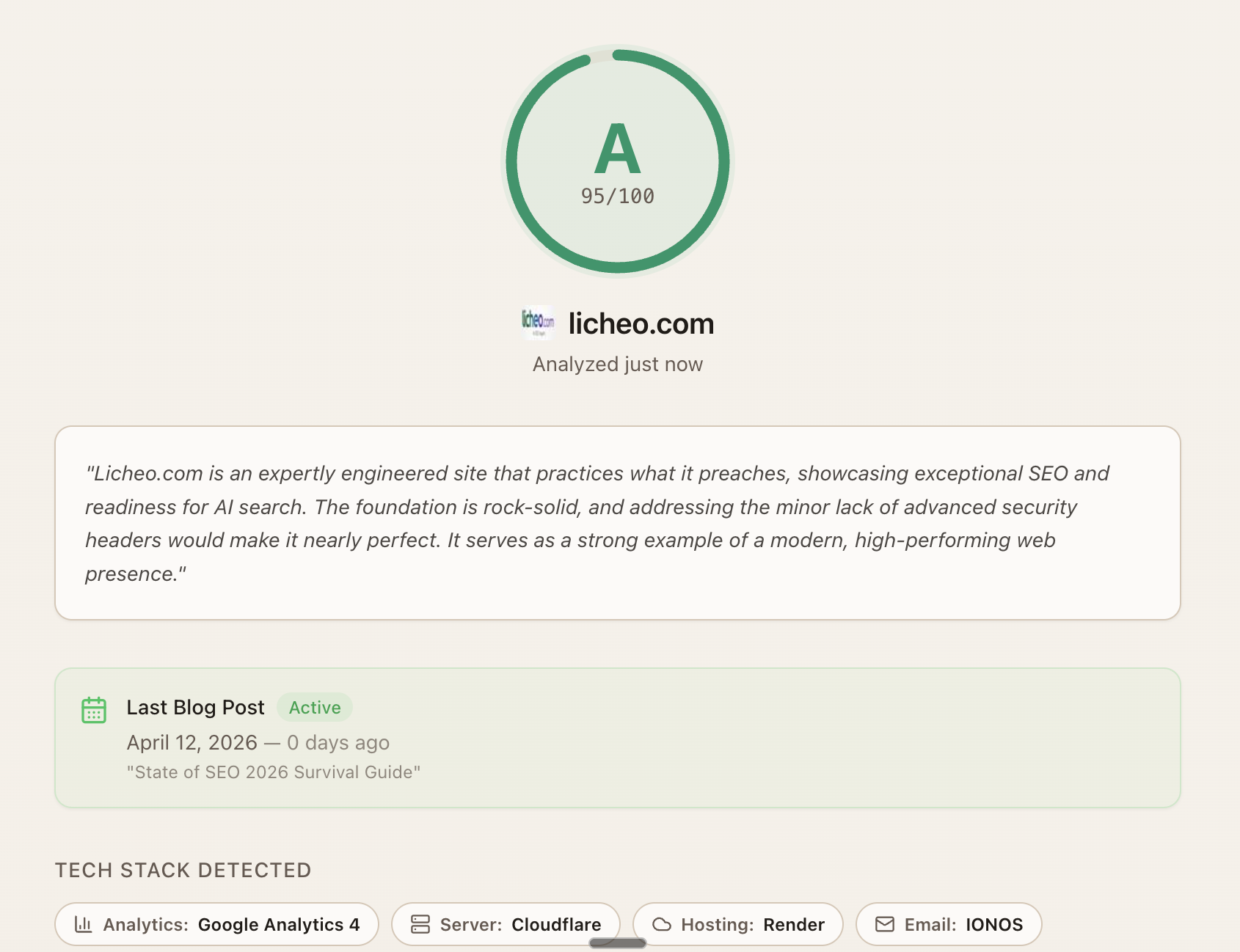
Now look at the contrast. The score circle is nearly complete: 95 out of 100, a grade of A. We ran our own site through the same analysis, because if we are going to tell you that scores matter, we should be willing to show ours.
The AI summary reads: "Licheo.com is an expertly engineered site that practices what it preaches, showcasing exceptional SEO and readiness for AI search. The foundation is rock-solid, and addressing the minor lack of advanced security headers would make it nearly perfect. It serves as a strong example of a modern, high-performing web presence."
Notice something important here: even at 95, the analysis found something to improve. Those missing advanced security headers are why it is 95 and not 100. No website is perfect, and a good analysis tool should tell you that honestly rather than flattering you.
The tech stack tells a different story from the F-graded site. Google Analytics 4 is properly configured, meaning we can track every visitor, every page view, every conversion. Cloudflare provides CDN and security at the edge. Render handles the hosting infrastructure. IONOS manages professional email. And the blog section shows the last post was published that same day, with an "Active" badge, a signal to both search engines and AI systems that this site is maintained and current.
The last blog post indicator is worth discussing specifically. Search engines and AI systems both factor in content freshness. A site that publishes regularly signals authority and relevance. A site that has not been updated in months or years signals abandonment. This is one of those details that many website owners overlook entirely.
What the gap really means
The distance between 19 and 95 is not just 76 points on an arbitrary scale. It represents two fundamentally different realities. The 19-scoring site is costing its owner money every day it exists in that state, not just the hosting fees, but the customers who search for that business, cannot find it, and go to a competitor instead. The 95-scoring site is an asset that works around the clock, attracting visitors from Google, being cited by AI search engines, and converting that attention into business opportunities.
The most important thing about this comparison is that the F-graded site is not unfixable. Every single issue the analysis identified has a solution. But the owner cannot fix what they do not know is broken, which is precisely why running the analysis is the essential first step.
What matters most: the score or the details?
Here is what I want you to understand, because it is genuinely the most important takeaway. The score is a compass, not a map. It tells you the general direction, whether you are in good shape, acceptable shape, or serious trouble. But the value is in the details beneath the score.
When we analyze a site, every finding comes with a severity level, a specific description of the issue, and a concrete recommendation for fixing it. A score of 55 could mean "your content is excellent but your technical foundation has three critical gaps" or it could mean "your technical setup is fine but your content is thin and your site has no AI search optimization." The number is the same but the prescription is completely different.
This is why running a proper analysis matters more than checking a quick score on some generic tool. The diagnosis needs to be specific enough to act on.
How to check your own website score
If you have read this far, you are probably wondering about your own site. Here is the straightforward path:
- Go to licheo.com and enter your website URL
- Our AI agents analyze over fifty factors across ten categories
- You receive a comprehensive score, letter grade, AI-generated summary, and detailed findings
- Each finding includes severity, impact, and specific recommendations
The analysis is thorough; it examines technical SEO, on-page optimization, content quality, AI search readiness, performance, security, and more. It is the kind of analysis that would cost several hundred dollars from a consultant, and it gives you a clear picture of exactly where you stand.
What to do after you get your score
The natural reaction to a low score is panic. Resist that. A low score is not a death sentence; it is a diagnosis, and most diagnoses have treatments.
If you scored in the A range, your focus should be on maintaining what you have and pushing into advanced territory: building topical authority, expanding your content depth, and ensuring your site is optimally structured for AI citation.
If you scored in the B range, identify the two or three findings with the highest impact scores and address those first. Often, the gap between a B and an A is a handful of specific, fixable issues.
If you scored in the C range, you likely need a systematic approach. The good news is that most C-range sites can reach B territory within 60-90 days with focused effort. The priorities are usually technical fixes first (they are fastest), then content depth, then AI optimization.
If you scored in the D or F range, the situation is urgent but not hopeless. The sites that score this low typically have a few critical failures that, once addressed, can move the score dramatically. We have seen sites go from the 20s to the 60s in a matter of weeks by fixing fundamental issues like missing SSL, adding proper meta tags, and creating substantive content.
The bigger picture: why this matters now more than ever
Let me be direct about something. The window for getting your website right is narrowing. Not because the internet is going away, quite the opposite. Because the competition for visibility is intensifying on multiple fronts simultaneously.
Google's traditional search results are more competitive than ever. AI search engines are creating an entirely new discovery layer that favors well-structured, authoritative sites. Voice assistants are answering questions by pulling from websites that are optimized for extraction. And your competitors, at least some of them, are already investing in all of this.
A website that scored 60 two years ago might have been "good enough." That same website, unchanged, might effectively score 45 today, because the bar has moved. The algorithms have become more sophisticated. The AI systems have higher standards for what they consider worthy of citation. And the businesses that are actively optimizing are pulling further ahead.
This is not meant to frighten you. It is meant to motivate you to check. Because the first step, and it really is this simple, is knowing your number. Not guessing. Not hoping. Knowing. And then making informed decisions about what to do next, based on data rather than anxiety.
Run your website through our analysis. See where you stand. And then decide, with full information, what your next move should be.