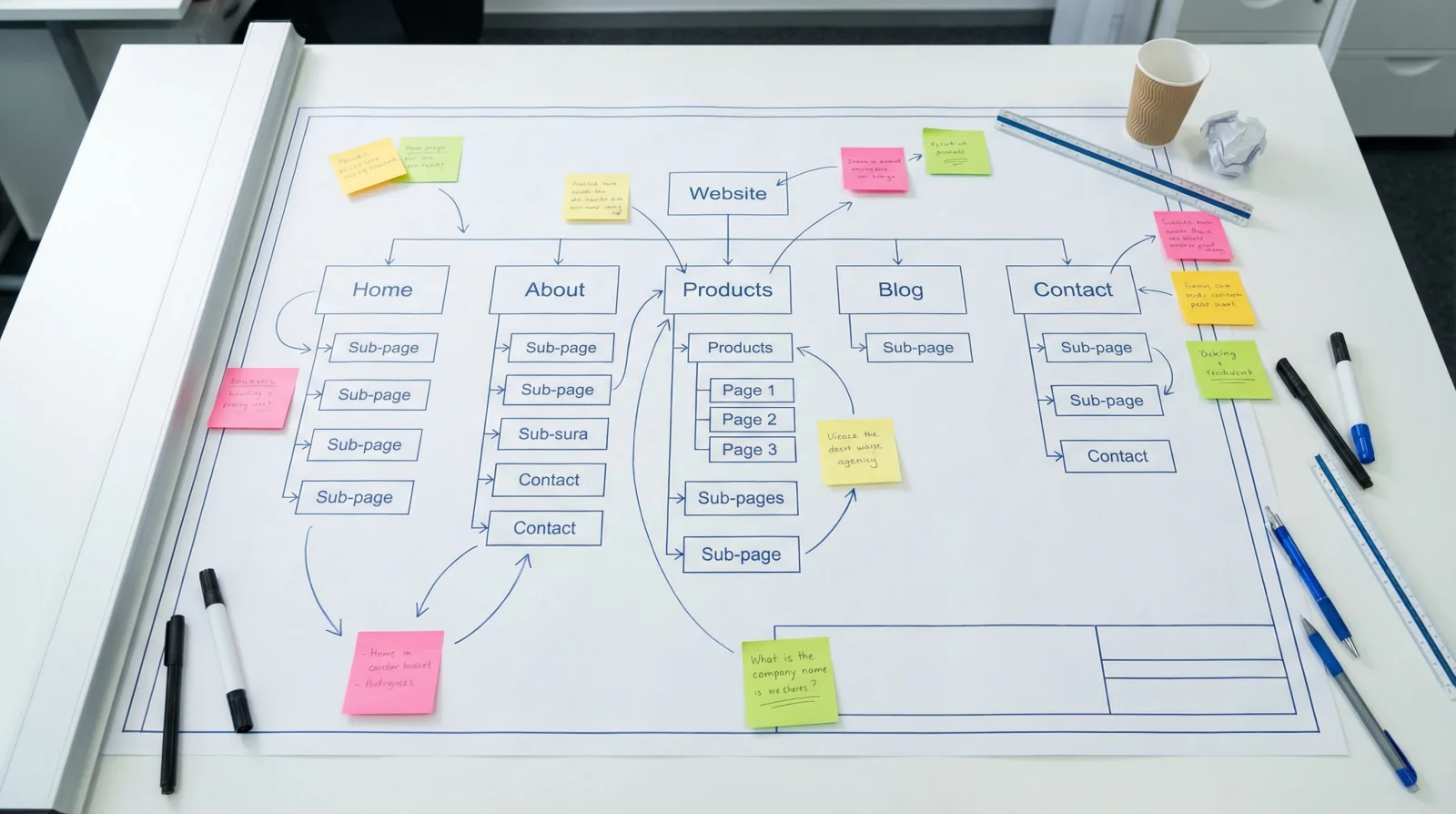
I spent most of February rebuilding the internal linking structure on a client's 4,000-page B2B site. Not because their rankings had tanked, they hadn't, at least not yet, but because I'd just read Google's SAGE research paper and it scared me enough to start making changes immediately. The paper, published January 26, 2026, introduced a concept that should make every technical SEO reconsider how they think about site structure: information co-location accounted for 35% of cases where deep research by AI agents proved unnecessary. That number stopped me cold. Over a third of the time, if the information was all in one place, the agent didn't need to go searching elsewhere. And if the agent doesn't need to go searching elsewhere, it doesn't need to visit your competitor's site.
That's the new game. Not just ranking. Not just traffic. Keeping the agent on your pages long enough that it never needs to leave.
What SAGE actually tells us
Let me back up and explain SAGE because I think a lot of the commentary around it has been either too breathless or too dismissive. SAGE stands for Steerable Agentic Data Generation for Deep Search with Execution Feedback. It's not a product. It's not coming to a search result near you. It's a research methodology, a way Google trained AI agents to handle complex, multi-step research questions. The system uses two agents: one writes a question, another tries to solve it. If the solving agent gets it too easily, that feedback loop makes the questions harder.
What matters for us isn't the methodology itself but what Google learned along the way. They discovered that their agents typically pulled from the top three ranked pages for each query they executed. Classic SEO visibility still matters, even in this new context. But here's the twist: when all the information needed to answer a question lived in a single document, the agent skipped the multi-hop research process entirely. It found the answer, used it, and moved on.
Previous AI benchmarks like Musique and HotpotQA required no more than four reasoning steps. The SAGE dataset pushed agents much further, into genuinely complex territory. But even in that complex territory, comprehensive single-page resources short-circuited the process over a third of the time. If you're building content that requires an agent to visit three different pages on three different sites to piece together an answer, you've already lost. Someone with a better-structured page is going to eat your citation.
The concept of agent hops and why they matter
I've started using the term "agent hops" with clients, and it clicks with them faster than any technical SEO jargon I've used in fifteen years. An agent hop is exactly what it sounds like: every time an AI agent has to leave one page and go find information somewhere else, that's a hop. Each hop is a chance for that agent to land on a competitor's content instead of yours.
Think about it from the agent's perspective. It gets a query like "what's the best CRM for small law firms with under ten employees?" It starts searching. It finds your page about CRM comparisons. Great. But your page only covers features and pricing. It doesn't mention anything about law-firm-specific workflows. So the agent hops to another site that has a page about legal CRM use cases. Then it hops again to find pricing information for small teams. Three hops. Three different sites. Your chance of being the primary citation just dropped significantly.
Now imagine a different scenario. The agent lands on a competitor's page that covers CRM comparisons, includes a section on legal-specific features, has a small-team pricing breakdown, and even mentions compliance considerations. One hop. Done. That page gets cited. Yours doesn't.
Reducing agent hops isn't just about making longer pages, though. It's about anticipating what questions an agent might chain together and making sure those answers live together. This is where site architecture becomes the deciding factor.
Hub-and-spoke, rebuilt for agents
The hub-and-spoke content model has been around for years. A central pillar page links to supporting cluster content, which links back. Simple enough. Most SEO teams adopted this for topical authority, and it worked well for traditional search. But the standard implementation has a problem for agentic search: it fragments information across too many pages.
In the traditional model, you'd have a pillar page on "CRM Software" that's maybe 3,000 words, linking out to 15 spoke pages covering subtopics like pricing, features, integrations, and use cases. Each spoke might be 1,500 words. The agent has to visit the hub, decide which spoke is relevant, hop to that spoke, then potentially hop to another spoke for related information. That's at least two or three hops just within your own site. And the agent may not even bother; it might find a single comprehensive page on another site and use that instead.
The revised model I've been building with clients keeps the hub-and-spoke structure but makes the hub much more self-contained. Think of it as a fat hub with thin spokes. The pillar page should be 5,000 to 10,000 words and should contain enough information to answer most agent queries on its own. The spokes still exist, but they serve a different purpose: they go deep on narrow subtopics for human readers who want exhaustive detail, and they provide additional context for agents doing genuinely deep research.
Every spoke should link back to the hub, the hub should link to every spoke, and critically, spokes should link to two or three other spokes in the same cluster. This creates a tight web of internal links that an agent can traverse quickly if it does need to hop. But the goal is to make that hopping unnecessary as often as possible by front-loading the hub with comprehensive, co-located information.
Internal linking as machine wayfinding
Here's something I think most SEOs are still underappreciating: internal links aren't just for PageRank distribution anymore. They're wayfinding signals for AI agents. When an agent lands on your page and needs to find related information, it reads your internal links to decide where to go next. The anchor text, the surrounding context, the position on the page, all of it matters in ways that go beyond traditional SEO.
I ran an experiment last month on a mid-size e-commerce site. We had two versions of a product category page. Version A used generic internal link anchors like "learn more" and "see details." Version B used descriptive, contextual anchors like "compare pricing tiers for small business plans" and "integration guide for Shopify stores." We tracked which pages agents were citing in AI Overviews and Perplexity responses. Version B's linked pages showed up in citations 40% more often over three weeks. That's not a controlled academic study, and I wouldn't publish it as one, but it was enough to convince me that anchor text quality matters specifically for agent navigation.
The placement of links matters too. Links in the first 30% of content get more attention, from both humans and agents. There's a stat floating around from Semrush's analysis that 44.2% of all LLM citations come from the first 30% of page text. I suspect that has less to do with some mysterious bias and more to do with the fact that well-structured content puts the most important information up front, and that information naturally attracts citations.
For machine wayfinding specifically, I recommend putting your most important internal links in the introductory section and in contextual callouts throughout the body. Don't bury your best cross-links in a footer or a sidebar that might not even render for certain crawlers. Make them part of the content flow where they'll be read in context.
The crawlability angle you might be ignoring
Here's a practical issue that's tripped up several sites I've audited recently: AI crawler access. You need to make sure GPTBot, ClaudeBot, PerplexityBot, and the various other AI crawlers can actually reach your pages. I've seen sites that blocked these crawlers in robots.txt either intentionally or accidentally, and then wondered why they weren't showing up in AI-generated answers.
There's a real tension here. Some publishers are blocking AI crawlers because they don't want their content used for training data. That's a legitimate choice. But you need to understand the trade-off: if you block AI crawlers, you're also blocking AI agents from discovering and citing your content in real-time search results. Those are two different use cases, and right now there's no clean way to allow one while blocking the other. The robots.txt protocol wasn't designed for this kind of nuance.
Page speed matters for agents too, and not in the same way it matters for humans. Sites with under one-second load times receive roughly three times more crawler requests from AI systems. Agents are impatient. They're running multiple queries in parallel, and they'll skip slow-loading pages in favor of faster alternatives. If your server takes three seconds to respond, the agent has already moved on.
I'd also pay attention to your site's technical structure from a rendering perspective. JavaScript-heavy single-page applications that require client-side rendering can be problematic for AI crawlers. Many of these bots don't execute JavaScript the way Googlebot does. If your content only appears after JavaScript runs, it might be invisible to half the AI agents out there. Server-side rendering or static pre-rendering solves this problem cleanly.
Structuring content for co-location
The SAGE research's co-location finding gives us a clear blueprint for content structure. When you're creating a page that targets a complex topic, think about what questions an agent might chain together, and make sure your page answers them all.
Here's my process, which I'll admit is still evolving. First, I identify the primary query the page targets. Then I brainstorm the likely follow-up questions an agent might generate after reading the initial answer. For a page about "best project management software for remote teams," the follow-ups might include pricing comparison, integration capabilities, specific features for asynchronous work, security considerations for distributed teams, and migration paths from common alternatives. All of those answers need to live on the same page, or at least be directly accessible within one hop via a clearly labeled internal link.
I use a technique I've been calling "answer stacking," structuring the page so each section answers a distinct but related question, with clear H2 and H3 headings that an agent can parse. The heading structure isn't just for humans scanning the page. It's a table of contents for agents deciding whether this page has what they need. If your headings are vague or cute instead of descriptive, you're making it harder for agents to assess your content's relevance.
Tables and structured data help enormously here. When you can present comparison data in a table rather than scattering it across paragraphs, agents can extract that information much more efficiently. Schema markup reinforces this: FAQ schema, HowTo schema, comparison schema all give agents additional signals about what information lives on the page without requiring them to parse every paragraph.
What this means for existing sites
If you have an established site with hundreds or thousands of pages, you can't rebuild everything overnight. Here's a prioritized approach based on what I've been doing with clients.
Start with your highest-traffic pages, specifically the ones that are already generating AI citations or appearing in AI Overviews. These are your strongest assets, and they're worth investing in first. Expand them with co-located information that addresses likely follow-up queries. Add descriptive internal links to related content. Make sure the heading structure is clean and parseable.
Next, look at your content clusters and identify fragmentation. If you have fifteen short posts covering different aspects of the same topic, consider whether you'd be better served by one comprehensive resource that pulls the best of each post together. I'm not saying delete the individual posts, that has its own risks, but create a definitive hub page that contains the key information from all of them. Let the individual posts handle the long-tail details.
Audit your internal linking with fresh eyes. Not for PageRank sculpting or link equity distribution: for agent wayfinding. Can an agent land on any page in a cluster and find its way to the most comprehensive resource within one click? If not, fix the links. Use descriptive anchor text that tells the agent exactly what it'll find at the destination.
Finally, check your technical fundamentals. Crawlability, page speed, rendering method, robots.txt permissions for AI bots. These aren't sexy tasks, but they're the foundation everything else sits on. A perfectly structured content hub doesn't matter if the agents can't access it.
The honest uncertainty
I want to be straightforward about something: we're still early in understanding how agentic search will evolve. The SAGE paper gives us real data about how Google is thinking about training AI research agents, and that data points clearly toward co-location and comprehensive resources as winning strategies. But Google's production systems may weight things differently. Other AI search providers definitely weight things differently. What works for AI Overviews might not work for Perplexity or ChatGPT search.
I also don't know how long the current advantage lasts. Right now, sites that restructure for agent consumption have a genuine edge because most competitors haven't done it yet. A year from now, everyone might be doing it, and the advantage will shift to something else, maybe the quality of proprietary data, maybe the freshness of information, maybe something we haven't thought of yet.
What I do know is this: Google explicitly showed that content architecture determines whether agents complete their research on your pages or go to competitors for missing information. That finding isn't going to reverse. The specific tactics might evolve, but the principle is sound: make your content comprehensive enough that agents don't need to leave. Build your architecture around that principle, and you'll be in a strong position regardless of how the details shake out.
The sites I've restructured over the past two months are already seeing changes in their AI citation patterns. Not dramatic overnight transformations, but steady improvements in how often their content gets referenced in agent-generated responses. For technical SEO in 2026, that's the metric that matters most. Not just where you rank in the blue links, but whether agents choose to stay on your pages or hop somewhere else.