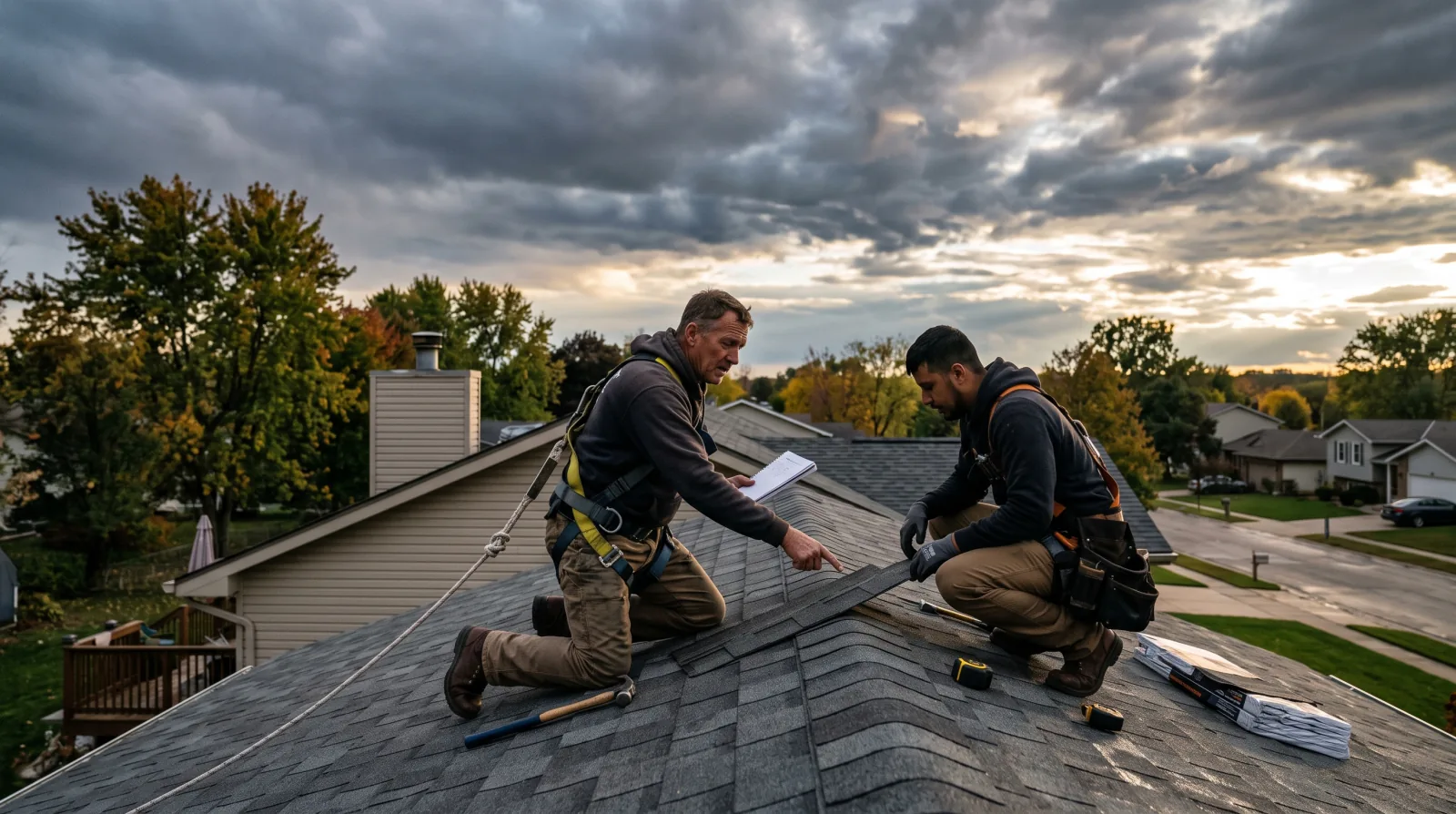
There is a particular kind of silence that settles over a neighborhood after a bad hailstorm. And then, almost at once, that silence breaks. Phones come out, neighbors compare notes across fences, and hundreds of homeowners in the same few square miles all reach for the same thing at the same moment: a roofer. Not next week. Now.
This is the strange, wonderful, brutal reality of the roofing business. Demand does not arrive gently, spread across the year like the work of a dentist or an accountant. It arrives in sudden, violent surges, and the companies that capture those surges are not necessarily the best roofers in town. They are the most visible ones. In storm season, visibility and craftsmanship are two entirely different games, and you must win both.
The short version: getting found first in storm season is not something you switch on when the clouds gather. It is built quietly in the calm weeks before: a Google Business Profile kept fresh and complete, a steady flow of recent reviews, dedicated pages for emergency and storm-damage work, and content that AI assistants can quote when a panicked homeowner asks their phone for help. Do this early, and when the hail hits, you are already at the top. Do it late, and you are shouting into a market that has already made its calls.
Why Does Roofing Search Behave So Differently From Other Trades?
Most local businesses live in a world of steady, predictable demand. A homeowner decides, over a few days, that the bathroom needs remodeling. They research, they compare, they take their time. The roofer's world is not like this at all.
After a storm, the decision compresses into minutes. A homeowner sees a dented gutter or a shingle in the yard, feels a flush of worry, and searches: "roof repair near me," "storm damage roofer," "emergency roof leak." They are not in a mood to evaluate twelve options. They call one of the first companies that appears, ideally one with a strong rating and a phone number they can tap immediately.
This means two things. First, the top three positions on Google Maps (what people call the "map pack") matter more for roofing than for almost any other trade, because the buyer barely scrolls. Second, the moment of the search is fixed and non-negotiable. You cannot decide, the day after the storm, to suddenly become findable. Google's trust in a business builds slowly, over months. A profile that has been dormant and then explodes with activity the day demand spikes looks, frankly, suspicious. The work must be done in advance.
What Should Roofers Do Before Storm Season Even Starts?
Let's be honest about the calendar. If you are reading this in the calm before your regional storm season, you are in the fortunate position. Here is the order of operations that consistently separates the roofers who thrive from the ones who scramble.
- Claim and complete your Google Business Profile fully. Every field: hours, service area, primary category ("Roofing contractor"), secondary categories, phone number, website. An incomplete profile is a leak in your roof, so to speak, that costs you rankings before a single customer ever calls.
- Set your service area with intention. Roofers are service-area businesses; you go to the customer. Define the towns and neighborhoods you genuinely serve, and make sure your website reinforces them. Our guide on local SEO for service area businesses walks through this in detail; it is essential reading for any roofer.
- Build a steady drip of recent reviews. Not a flood in one week, but a genuine, ongoing stream. According to BrightLocal's 2026 Local Consumer Review Survey, 74% of consumers only want reviews written within the last three months, and 32% want them from the last two weeks. Old reviews, however glowing, quietly lose their power.
- Create dedicated emergency and storm-damage pages. A homeowner searching "hail damage roof repair" should land on a page about exactly that, not your generic homepage. More on this below.
- Keep the profile warm. Post updates, add fresh photos of completed jobs, answer questions. An active profile signals to Google that you are a living, working business, and prominence rewards that activity.
The roofers who follow this order are not gambling on the weather. They have built the roof over their own business before the first drop falls.
How Important Is Google Business Profile for a Roofer, Really?
More important than your website, if I am being direct. When someone searches for a roofer on a phone, the map pack sits above the regular results, and for urgent local needs the great majority of clicks land there. Your Google Business Profile is your storefront in that moment.
Google decides who appears in the map pack using three factors it states openly: relevance (does your business match the search), distance (how close you are to the searcher), and prominence (how well-known and trusted you are). You cannot change your physical location, and distance is largely fixed. But relevance and prominence are entirely within your control.
Relevance comes from your primary category and the words on your profile and site. Prominence comes above all from reviews: their number, their rating, and crucially their freshness. A roofer with forty recent, four-and-a-half-star reviews will, in nearly every case, outrank a better roofer with eight reviews from two years ago. It is not fair, perhaps, but it is how the game is played. If your review engine is neglected, start there. Reviews are, without doubt, the single most powerful lever a roofer can pull, and we explain the full strategy in why Google reviews are your secret SEO weapon.
What Pages Should a Roofing Website Actually Have?
Here is a mistake I see constantly. A roofer builds a beautiful homepage that says "We do roofing!" and then wonders why storm searches never find them. The problem is that a homeowner never searches "we do roofing." They search for their exact, specific, worried problem.
Your website needs pages that match those searches, one page per real intent:
- Emergency roof repair: for the leak-at-2am panic search. State your response time. Put the phone number everywhere.
- Storm and hail damage: this is your storm-season workhorse. Explain what hail damage looks like, how the inspection works, what to do before the adjuster arrives.
- Insurance claim assistance: storm-damage buyers are terrified of the insurance process. A page that calmly explains it builds enormous trust.
- Service-area pages: one for each genuine town or region you cover, with real, distinct content (never copy-pasted, which Google and readers both dislike).
- Roof replacement and specific materials: asphalt shingle, metal, tile, flat roofing.
Each page should answer the homeowner's real questions in plain language. This is not only good for search; it is exactly the kind of clear, expert content that AI assistants pull from when someone asks their phone a question. And for the broader picture of how contractors should structure all of this, our SEO guide for contractors ties the whole approach together.
What About AI Search? Do Roofers Really Need to Worry About It?
Yes, and more than you might think. The habit of asking an AI assistant (ChatGPT, Perplexity, Google's AI answers) for a recommendation is now genuinely mainstream. ChatGPT alone reached 800 million weekly users, according to figures reported in 2025. A meaningful share of homeowners, especially younger ones, now ask "who's a good roofer near me for storm damage" to an assistant before they ever open Google Maps.
Here is the encouraging truth: the same work that wins map-pack rankings also wins AI citations. Clear, well-structured pages that plainly answer real questions; a complete and consistent business profile; genuine reviews; local relevance stated explicitly. AI assistants are, in a sense, reading the web the way a very diligent customer would, and they favor the businesses that have organized their information honestly and clearly. The roofer who did the boring, careful work of storm-season SEO is also the roofer the AI recommends. One effort, two rewards.
A Quick Story From the Field
I spoke with a roofing company owner in a hail-prone region who told me something that has stayed with me. For years, he said, he treated marketing like an umbrella, something you grab only when it is already raining. Every storm season he would panic, throw money at ads for a few frantic weeks, and watch most of the leads go to two competitors who always seemed to sit at the top of the map.
Then, one quiet winter, he did the unglamorous work instead. He completed his profile properly, built a simple system to ask every happy customer for a review the same day the job finished, and wrote real pages about hail damage and the insurance process. Nothing dramatic. Just steady, patient preparation.
The next storm season, he told me, the phone rang differently. Not because a storm was bigger, but because when it came, he was already there, already trusted, already visible, already the name people saw first. "The truth is," he said, "I did not win storm season during the storm. I won it in February." That, in the end, is the entire lesson.
Storm season rewards the prepared, not the panicked. If you would like a clear, honest picture of where your roofing business currently stands in local and AI search, and what to fix before the next storm, see your SEO standings, or let our team handle the whole thing for you with our done-for-you SEO service. The best time to build was last winter. The second-best time is today.