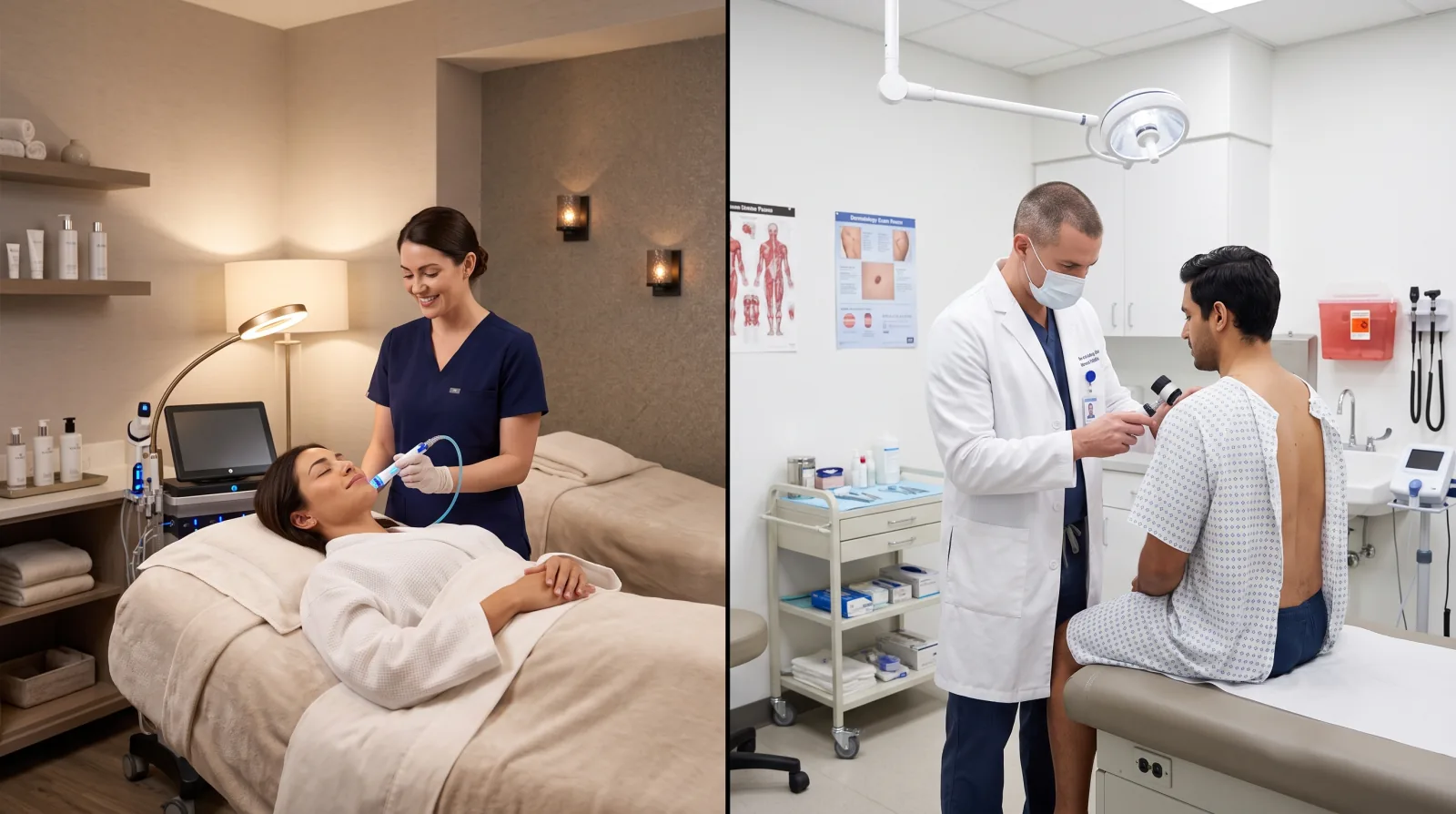
Editorial note: This article covers digital marketing and SEO strategy for med spas and dermatology clinics. It does not constitute clinical, regulatory, or compliance advice. Rules governing healthcare and aesthetic-medicine advertising vary by jurisdiction; consult your state medical board and relevant advertising standards before implementing any marketing strategy.
Here is a question that puzzles more business owners than you might expect. You run a med spa (or perhaps a dermatology clinic) and the business down the street, the other kind, offers half the same treatments you do. The people searching are typing the exact same things: "Botox near me," "laser hair removal," "acne treatment," "chemical peel." So why do patients find one of you, trust one of you, and call one of you, and not the other? The truth is that these two adjacent businesses live in different worlds of trust, and Google, and now the AI assistants people ask for recommendations, read those worlds very differently. Follow your neighbour's playbook, and at least one of you is doing it wrong.
The instinct to treat them the same is understandable. On the surface, the services overlap heavily; a good deal of what a med spa offers can also be found, in some form, inside a dermatology practice. But the patient arrives in a completely different emotional and psychological state, the businesses carry different levels of medical authority, and the signals that make each one trustworthy are almost mirror images of each other. To ignore this is to spend money and effort pushing in the wrong direction.
The short version: both med spas and dermatology clinics are treated by Google as "your money or your life" topics, which means both must demonstrate real expertise and trustworthiness. But a dermatology clinic wins through medical authority and credentialing, while a med spa wins through transformation, experience, and warmth. The treatment pages, the review psychology, and the trust signals that AI reads should be tuned differently for each. Below, we walk through exactly how.
What does "YMYL" mean, and why does it govern both businesses?
Let us define the term the first time it appears, because it explains almost everything that follows. "YMYL" stands for "your money or your life." It is Google's own shorthand for topics that can genuinely affect a person's health, safety, or finances, and Google's guidelines instruct its human quality raters to hold content on these topics to a much higher standard of expertise and trustworthiness (Google Search Quality Rater Guidelines).
Anything touching medical treatment, injectables, or skin procedures falls squarely inside this category. So both a med spa and a dermatology clinic are judged more strictly than, say, a pizza restaurant. Neither can simply write cheerful marketing copy and expect to rank. Both must show, in a way Google and AI can read, that real qualified people stand behind the words on the page.
But, and this is the crucial fork in the road, the two businesses possess very different kinds of authority to demonstrate. And this is where their strategies diverge.
How should a dermatology clinic lean into medical authority?
A dermatology clinic holds a powerful card that a med spa usually does not: genuine, verifiable medical credentials. Board-certified dermatologists, physicians, years of training, sometimes hospital affiliations. In the world of YMYL search, this is gold, and the clinic should never be shy about it.
The strategy for a dermatology clinic, then, is to make its expertise unmistakable:
- Name the doctors, everywhere. Author your treatment and condition pages under the actual physicians, with their credentials and short professional biographies. Google's emphasis on experience, expertise, authoritativeness, and trust rewards content that is clearly written or reviewed by real qualified people.
- Go deep on conditions, not just treatments. A dermatology clinic can rank powerfully for the medical side of a topic ("what causes cystic acne," "how melanoma is diagnosed") because it has the authority to speak on it. This deep, genuinely educational content is exactly what AI assistants love to cite.
- Use structured data to state your medical nature. Marking up your pages so search engines understand you are a medical clinic, with named practitioners, strengthens the trust signal. Our local business schema guide explains this in plain language.
For a dermatology clinic, the tone can and should be authoritative, calm, and clinical. The patient searching for "is this mole dangerous" is not looking for warmth first; they are looking for someone who clearly knows.
How should a med spa win on transformation instead?
Now flip the whole thing over. A med spa usually operates under medical supervision, but its front-facing identity is not primarily the physician; it is the experience and the result. The patient searching for "Botox near me" or "best facial for glowing skin" is, in most cases, not frightened. They are hopeful. They are buying a transformation and an experience, and their decision is far more emotional and aesthetic.
So the med spa's strategy leans in a different direction, without ever abandoning the credibility that YMYL demands:
- Show the transformation. Before-and-after imagery (handled carefully and with consent), clear descriptions of what a treatment feels like, and what a realistic result looks like. The med spa sells the outcome and the feeling.
- Make the treatment pages warm and specific. A page for "lip filler" should speak to the hopes and the small anxieties of the person considering it (downtime, comfort, natural-looking results) rather than reading like a clinical monograph.
- Still show the medical backing. Because it is YMYL, the med spa cannot skip credibility entirely. Name the medical director, note the supervising physician, be transparent about safety. But this is the reassuring foundation, not the headline.
A med spa I spoke with had, with the best intentions, hired a writer who produced beautifully technical, almost academic pages about the pharmacology of neuromodulators. The pages were accurate and completely cold. They ranked poorly and converted worse, because the person reading them wanted to feel confident and cared for, not lectured. Rewriting those same pages in a warm, reassuring, human voice (while keeping the medical facts correct) changed everything. The information was the same; the emotional temperature was not.
Why does review psychology differ between the two?
Reviews matter enormously for both businesses; the research is unambiguous that the great majority of consumers read reviews before choosing a local health or beauty provider (BrightLocal Local Consumer Review Survey). But what a prospective patient is reading for differs sharply.
For a dermatology clinic, the reader is often scanning for reassurance about competence and seriousness: Was the diagnosis right? Was the doctor thorough? Did they take my skin cancer concern seriously? The most valuable reviews speak to medical trust.
For a med spa, the reader is scanning for a very different thing: Did I get the result I wanted? Was the experience pleasant? Did I look natural, not frozen? Was the staff warm? The most valuable reviews speak to transformation and experience.
This has a practical consequence. When you gently encourage reviews (and you should, steadily rather than in bursts), the moments and the prompts differ. A dermatology clinic naturally earns its trust reviews after a thorough consultation; a med spa earns its transformation reviews when the patient sees their result and feels delighted. If you would like a fuller method, our reviews strategy guide is a good companion.
Which trust signals do AI assistants read for each?
When someone asks ChatGPT or Perplexity, used now by an enormous and growing audience (TechCrunch, on ChatGPT reaching 800M weekly users): "who is a good dermatologist for acne in [city]" versus "where can I get natural-looking Botox in [city]," the assistant is reading different trust signals to answer.
For the dermatology query, it leans toward verifiable medical authority: named board-certified physicians, professional affiliations, in-depth medical content, consistent professional listings. For the med spa query, it still checks legitimacy, but it weighs experiential signals more: strong recent reviews about results and experience, clear service descriptions, an active and reassuring presence. In both cases, the businesses already doing local search properly are the ones AI is most comfortable naming, because the machine, cautious by nature on health topics, wants to verify before it recommends.
Putting it into practice for your specific business
So the lesson, in the end, is one of self-knowledge. Before you write a single treatment page or ask for a single review, be honest about which business you truly are (a medical authority, or a transformation experience) because the same keyword will reward you for leaning into your real strength and quietly penalise you for imitating your neighbour.
If you would like an outside read on where you currently stand and which signals you are missing, our SEO standings check will show you plainly. And if you would rather have the whole strategy (the treatment pages, the reviews, the AI trust signals) built and maintained for you so your clinical time stays clinical, our done-for-you SEO page explains how that works. You can also see the broader approach for aesthetic and wellness businesses on our spa SEO hub.