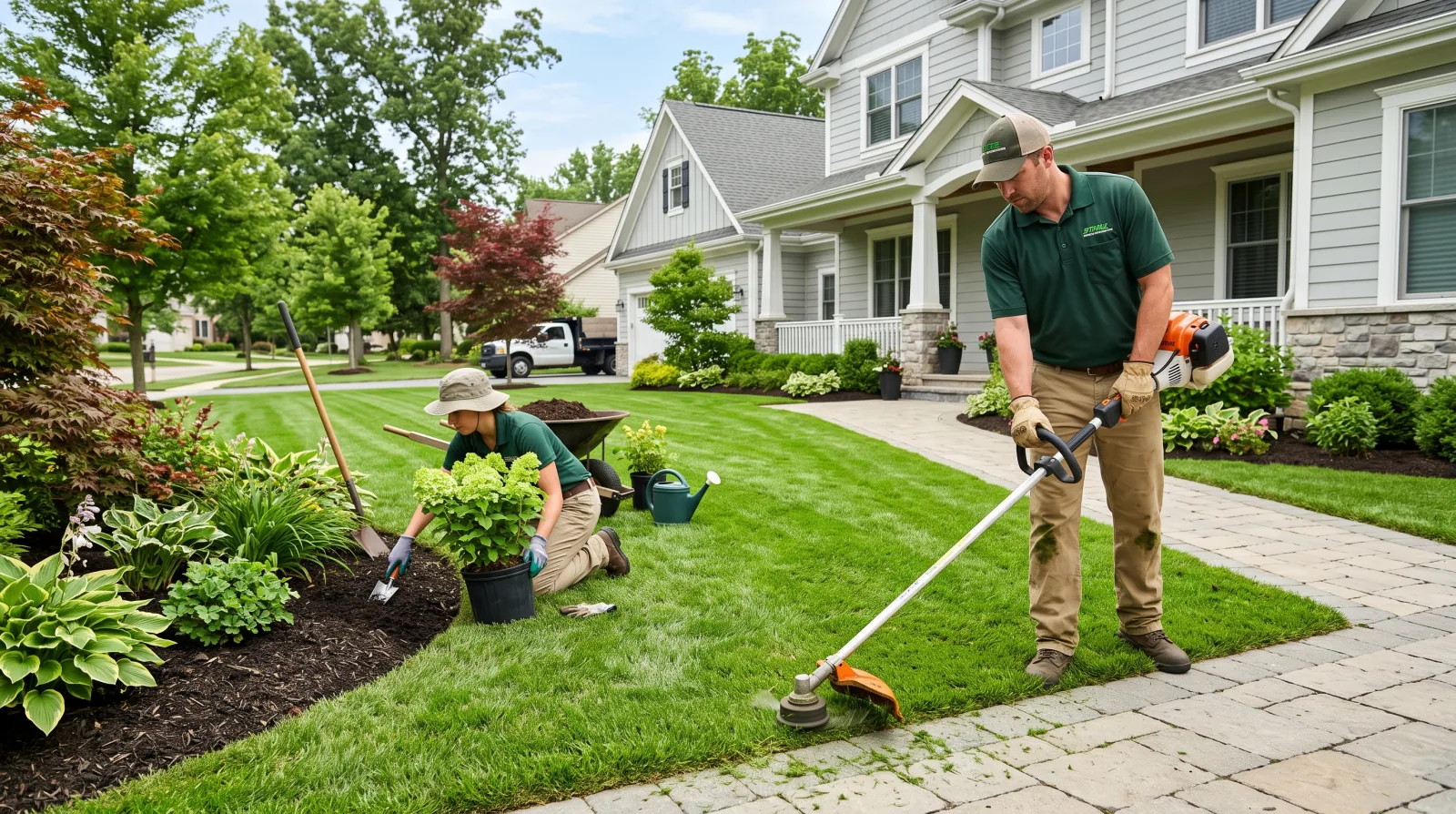
Let me start with something every good landscaper already knows in their bones: this business is sold with the eyes. A homeowner does not fall in love with a paragraph describing your "comprehensive approach to outdoor living." They fall in love with a photograph: a tired, patchy lawn on the left, a lush green carpet on the right, and they think, quietly and immediately, "I want that for my house." The transformation is the pitch. The proof and the promise, all in one image.
Here is the thing that surprises many landscapers: search works in almost exactly the same way. When someone opens Google and types "landscaper near me," the businesses that win are not the ones with the cleverest words; they are the ones whose presence is visual, trusted, and, crucially, present at the right moment in the season. Because landscaping and lawn care live and die by the calendar. The demand surges in spring, holds through summer, spikes again with the autumn leaves, and then falls to near silence in winter. Winning search in this business means understanding both halves: the visual trust that closes the customer, and the seasonal timing that puts you in front of them when it matters.
TL;DR: Landscaping is a visual, seasonal business, and your SEO must reflect both. Win local search in 2026 by fully optimizing your Google Business Profile with real, recent before-and-after photos, gathering fresh reviews after every job, building dedicated service pages for each job type and city, and, most importantly, publishing seasonal content before the season turns, because SEO takes months to mature. Structure it all clearly enough that both Google and AI assistants can trust and recommend you.
Why is getting found online different for landscapers?
Because it combines two forces that most businesses only feel one of: it is intensely visual, and it is intensely seasonal. A lawyer's website can succeed on words alone. A landscaper's cannot; the homeowner needs to see what you can do. And a dentist has fairly steady demand all year, while a landscaper faces a demand curve that rises and falls dramatically with the weather.
These two forces shape everything. The visual nature means photos are not decoration on your listing and website; they are the core of your conversion. The seasonal nature means timing is not a minor consideration; it is the difference between catching the spring rush and missing it entirely. And here is the part that trips up so many landscapers: because SEO takes weeks or months to mature, the content that wins April's "spring cleanup" searches must already be ranking before April. You cannot publish it when the demand arrives; you must publish it in the quiet of winter, when nobody is calling, so it is ready when everybody is.
How should landscapers optimize their Google Business Profile?
Your Google Business Profile (the listing that appears in Google Maps and the local "map pack") is your most valuable asset, and for a visual business like yours, one element towers above the rest: photos.
Load your profile with real, recent, high-quality images of your actual work. Before-and-after pairs are the most persuasive thing you can possibly show; a homeowner sees the transformation and imagines their own yard. Do not use stock photography, and do not lean on a logo; nothing earns trust like genuine work in genuine yards in the area you serve. Beyond photos, fill in everything: the correct primary category (Landscaper, Lawn Care Service, or the most accurate fit), your true service area, your hours, and every specific service you offer: lawn maintenance, spring and autumn cleanups, mulching, sod installation, hardscaping, tree and shrub care. Each listed service gives Google another way to match you to a homeowner's search.
For the complete method on ranking a business that travels to customers across many neighborhoods rather than working from a single storefront (which is every landscaper), our guide on local SEO for service area businesses walks through the whole approach, and every principle in it applies directly to your work.
Why do reviews matter so much for lawn care and landscaping?
Because when a homeowner sees two landscapers side by side at the top of the map, both with lovely photos, the tiebreaker is the reviews: how many, how recent, how highly rated. Photos earn the interest; reviews close the trust.
BrightLocal's ongoing Local Consumer Review Survey consistently finds that the great majority of consumers read online reviews when choosing a local business, and that recency and rating strongly shape their decision. For a business where quality and reliability are the whole promise (will they show up, will they do good work, will they treat my property with care), those reviews carry enormous weight.
The habit to build is simple to describe and requires genuine discipline to sustain: ask for a review after every completed job, make it effortless with a direct link, and respond to each review you receive. Recent reviews signal to both Google and to prospective customers that you are active, busy, and trusted right now. Our full breakdown of why reviews are the secret SEO weapon shows exactly how to weave that habit into your daily operations.
What pages should a landscaping website have?
Here is where most landscaping websites leave money on the table. They have a single "Services" page that lists everything vaguely, and they hope Google will rank it for every job in every town. It will not, because it is not specific enough to win any single search decisively.
Here is the structure that actually works, built step by step:
- A dedicated page for each service. One page for lawn maintenance, one for spring cleanups, one for sod installation, one for hardscaping, and so on. Each should genuinely answer what a homeowner wants to know: what the service involves, what it typically includes, and what to expect.
- A dedicated page for each city or neighborhood you serve. Combine them where sensible: "lawn care in [city]" is a far stronger match than a generic services page.
- Real photos on every page. This is a visual business; show before-and-after transformations, real yards, real work, tied to the local area where possible.
- Answer-first content. Because AI assistants and Google reward direct answers, open each page by answering the homeowner's core question in the first paragraph.
- Seasonal pages published early. Have your spring cleanup content ranking before spring, your leaf removal content before autumn. Build in the quiet season for the busy one.
- Clear, honest service-area language. Tell homeowners plainly which towns you cover, so both they and Google know exactly where you work.
How do landscapers get recommended by AI assistants?
This is the newest opportunity, and it is growing steadily. Homeowners increasingly ask AI assistants rather than typing into a search box: "who does lawn care near me?" or "best landscaper for a backyard renovation in [city]?" And the assistant answers with a shortlist, often naming specific businesses.
To be on that list, your business must be legible to a machine. That means a complete, consistent Google Business Profile rich with real photos, a website with clear answer-first content and proper business structure, and a healthy flow of genuine reviews. The clarity and trust that persuade a homeowner also persuade an AI. In the end, both audiences are asking the same simple question: "who can transform my yard, near me, and can I trust them?" The business that answers that question most clearly and visibly tends to win both.
A short story about the spring that was won in January
A lawn care operator I spoke with used to dread the same cycle every year. Spring would arrive, the phone would finally ring, and he would rush to update his website and pour money into ads to catch the rush, always a step behind, always paying full price for every lead. One winter, on advice, he did something different. In the quiet of January, when not a single customer was calling, he built individual pages for spring cleanup, for lawn maintenance, for the specific towns he served, and he filled them with before-and-after photos from the previous season's best work.
When spring came, something had shifted. Homeowners were finding those specific pages directly through Google, drawn in by the photographs. His reviews, which he had finally started collecting after every job, sealed the trust. And, to his surprise, a customer mentioned that an AI assistant had recommended his company by name when they asked about lawn care in their town. His ad spend that spring fell, and his booked jobs rose. He had won the spring rush in the depth of winter, simply by preparing before the season turned. That, alla fine, is the whole secret of seasonal SEO: the work that wins the busy season is done in the quiet one.
Want to see exactly where your landscaping business stands in Google Maps and AI search before the next season turns? Check your SEO Standings for a clear picture, or let our done-for-you SEO team prepare your seasonal pages and profile the right way, well ahead of the rush.