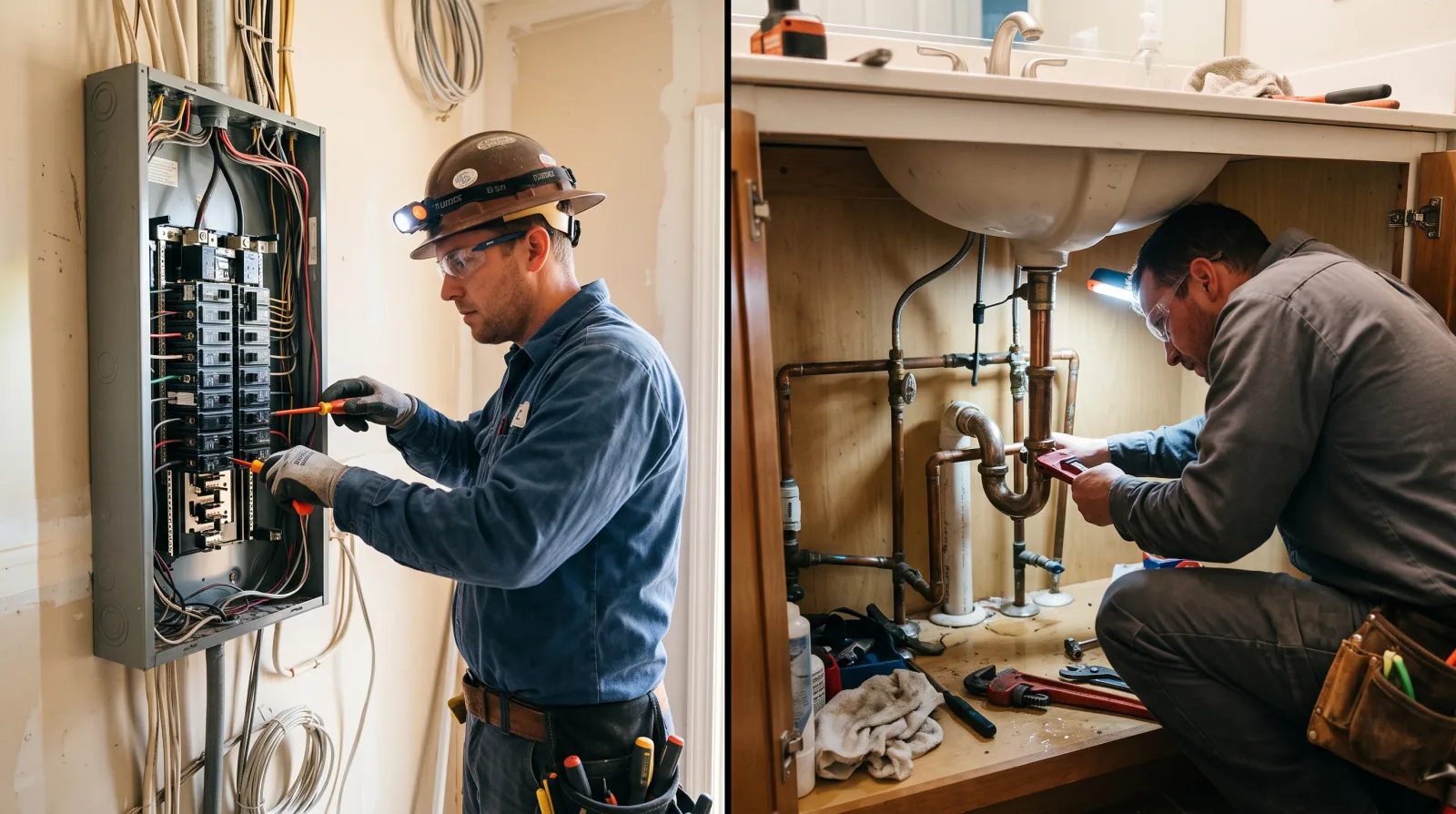
If you were to place an electrician's marketing plan and a plumber's marketing plan side by side, you might, at first glance, struggle to tell them apart. Both live or die by the Google Business Profile that puts them on the map. Both depend on a steady flow of recent reviews. Both need a website that turns a worried homeowner into a phone call within seconds, service pages that answer the questions people genuinely search, and a presence that AI assistants can find and recommend. The playbook, in its bones, is the same, and this is precisely why so many contractors in both trades copy each other's approach without a second thought.
And yet, the truth is that these two trades are not the same at all, and the difference sits in the emotional state of the person doing the searching. When a pipe bursts, water is actively destroying a home; the search is frantic, the intent is "get someone here now," and the contractor who answers fastest tends to win. When a breaker trips or an outlet sparks, the situation is often frightening but stable; the homeowner has a moment to read, to compare, to choose the electrician who explains the risk most clearly and inspires the most trust. Same playbook, then, but a different emergency, a different emotion, and, alla fine, a different accent on the very same tactics. This guide walks through where they align and, more usefully, where they must diverge.
Here is the short version. Electricians and plumbers share the core local search playbook: an optimized Google Business Profile, fresh reviews, a fast mobile website, question-answering service pages, and AI visibility. But plumbing skews toward acute, panic-driven emergencies where speed and availability signals win, while electrical work blends genuine emergencies with a large share of planned, higher-consideration jobs (panel upgrades, rewires, EV chargers) where safety credibility and trust win. The strategic error, seen constantly, is an electrician marketing like an emergency plumber, or a plumber burying their emergency availability where a panicking homeowner cannot find it. Match the message to the customer's actual state of mind, and both trades pull ahead.
What Do Electricians and Plumbers Have in Common?
Almost everything at the level of tactics, which is why the shared playbook exists and works. In both trades, the great majority of new customers begin with a local search, most never scroll past the map results with their three highlighted businesses, and reviews do much of the deciding from there. BrightLocal's 2026 Local Consumer Review Survey confirms that consumers lean heavily on reviews and ratings before choosing any local business, and neither trade is an exception.
So the common foundation is genuinely common. A complete and active Google Business Profile in the correct categories. A patient system for gathering recent reviews rather than a stale pile from three years ago. A website that loads quickly on a phone and shows the phone number without hunting. Service pages that answer real questions in plain language. And, the newest pillar, a presence structured so that ChatGPT and Perplexity can find and confidently recommend the business, since BrightLocal found 45% of consumers now use AI tools to find local businesses, up from just 6% a year earlier. Both trades should be doing all of this. If you run either, our hub pages for electrician SEO and plumber SEO lay out the shared foundation in detail.
The encouraging part, common to both, is that in most service areas almost nobody is doing this work seriously. The bar, let's say, remains refreshingly low.
How Different Is the Customer's State of Mind in Each Trade?
Profoundly, and this is the single most useful distinction to grasp. Plumbing emergencies tend to be acute, visible, and terrifying in the moment. A burst pipe, an overflowing toilet, a water heater flooding a basement: these are situations where damage compounds by the minute, and the homeowner's search reflects pure panic: "emergency plumber near me," "24 hour plumber," "water leak repair now." In that state, nobody reads a carefully worded About page. They call the first credible business that appears available. Speed wins.
Electrical emergencies exist too (a sparking outlet, a dead panel, the acrid smell of burning) and they are genuinely dangerous. But a great deal of electrical work is different in character: planned, considered, and often expensive. A panel upgrade, a whole-home rewire, an EV charger installation, adding circuits for a renovation. Here the homeowner is not panicking; they are researching. They read. They compare. They want to understand why the older aluminium wiring is a risk, what a service upgrade involves, whether the electrician is licensed and insured. Trust and safety credibility win, because the decision is deliberate rather than desperate.
We have explored the frantic end of this spectrum in how plumbers get recommended in ChatGPT and AI search, and the lesson there, that a plumber must be instantly, obviously available, is the crux of the plumbing side of this comparison.
Which Searches and Messages Should Each Trade Lead With?
Different ones, drawn from these two different emotional states. Let me lay the contrast out plainly, trade by trade, so the accent becomes clear.
- Plumbers should foreground urgency and availability. Emergency service, 24-hour response, "we can be there today": these belong at the top of the page, in the profile description, in the headline. The panicking searcher must see availability in the first two seconds, or they are already dialing your competitor. Burying "emergency service" three clicks deep is, for a plumber, a genuine and costly mistake.
- Plumbers should still build trust pages, but not lead with them. Content on repiping, water heater choices, and preventing frozen pipes matters for the considered jobs and for AI visibility, yet it must not obscure the emergency signal.
- Electricians should foreground safety, licensing, and expertise. For the considered work, the homeowner is evaluating whether to trust you inside their walls. License numbers, insurance, safety explanations, and clear educational content on panel upgrades, EV chargers, and rewiring do the persuading.
- Electricians should absolutely keep an emergency signal too, just not as the whole identity. The sparking-outlet searcher needs to find you fast, but if your entire presence screams "emergency" you undersell the planned, profitable work.
- Both should answer real questions on their sites. "How much does a panel upgrade cost," "why is my breaker tripping," "how do I stop a running toilet," "signs my water heater is failing": these pages serve searchers and feed the AI assistants at once.
The principle beneath all five is simple, and I return to it often: match the message to the moment. A homeowner standing ankle-deep in water and a homeowner planning an EV charger are not the same customer, even if they live next door.
Where Do AI Assistants and Reviews Change the Picture?
They raise the stakes for both trades, but in slightly different ways. When someone asks ChatGPT "who is a reliable emergency plumber near me," the model favors businesses whose availability, service area, and strong recent reviews are clearly and consistently expressed; the same speed-and-trust signals that win the frantic search, now filtered through an AI. When someone asks "who is a good electrician for a panel upgrade in my city," the model leans toward businesses that demonstrate licensing, expertise, and a solid reputation for exactly that kind of considered work.
Reviews, meanwhile, do heavy lifting in both, but read them closely and you will notice the emotional difference echoed there too. Plumbing reviews often praise speed and rescue: "came within the hour, saved our kitchen." Electrical reviews often praise clarity and confidence: "explained everything, made me feel safe, no surprises on the bill." Encouraging the right kind of review (nudging happy customers to mention what actually matters in your trade) quietly strengthens the exact signal each business needs. Our guide to reviews as your secret SEO weapon covers the mechanics for either trade.
I spoke recently with an electrician who had, in his own words, "copied the busiest plumber in town," plastering "24/7 EMERGENCY" across everything. His emergency calls did rise a little. But his profitable panel and EV work quietly dried up, because homeowners planning those jobs assumed he was strictly a break-glass, middle-of-the-night operator. Once he rebalanced, safety and expertise front and center, emergency availability present but not dominant, the considered work returned. Same tools, wrong accent, correctable in an afternoon.