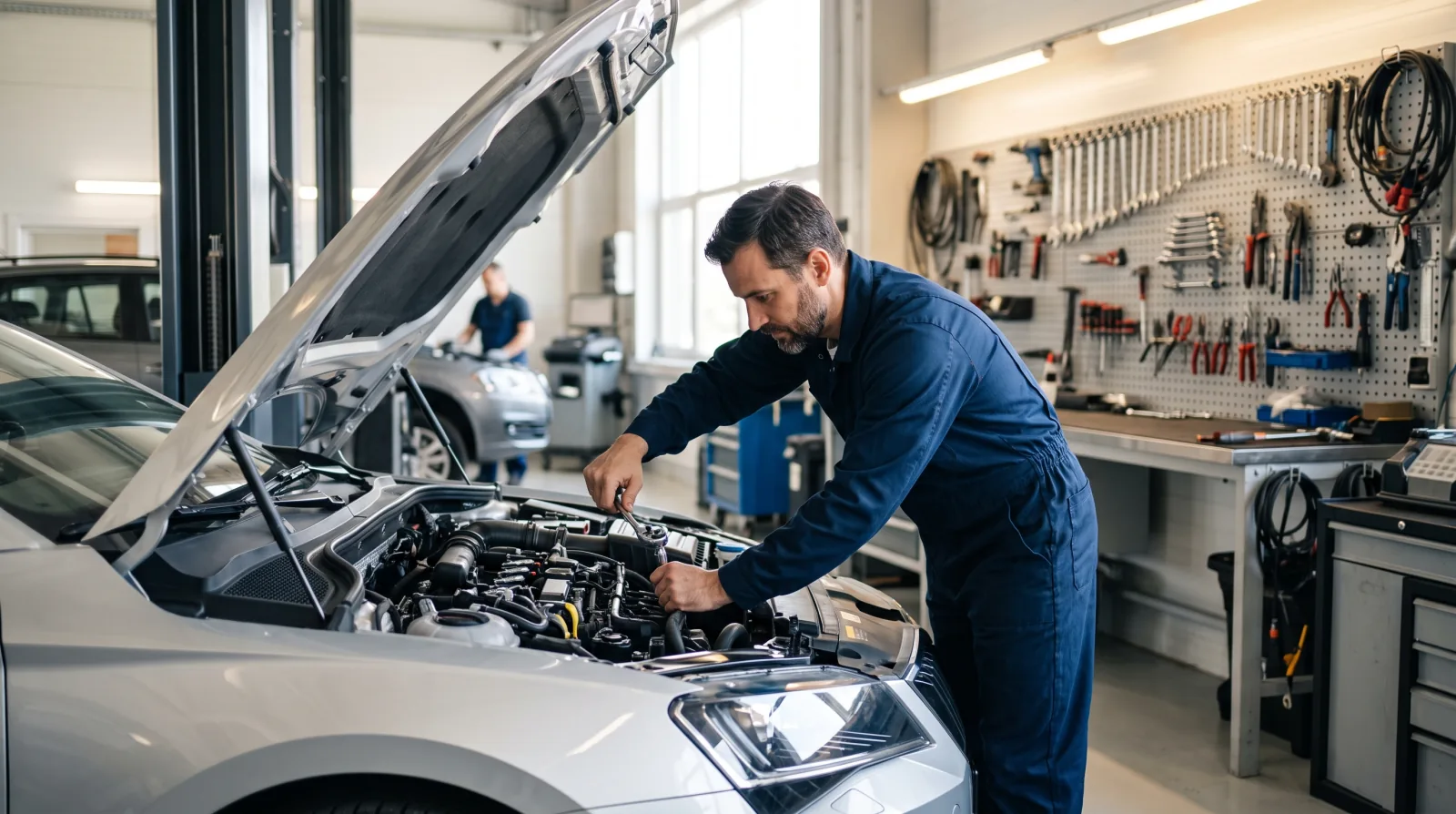
How does a repair shop get more customers today? The answer begins with a question you can ask yourself: think, for a moment, about how you last chose a mechanic. If you are like most people, you did not ask a neighbor over the fence. You pulled out your phone, typed something like "mechanic near me" or "brake repair near me," and looked at what came up -- the ratings, the reviews, the photos, whether the shop was open, how far away it was. The decision was largely made before you ever picked up the phone to call. This shift, from word-of-mouth to search-and-compare, is the single most important thing an auto repair shop must understand about winning customers in 2026.
And the volume of this behavior is enormous. Terms like "mechanic near me" and "auto repair near me" together pull in an extraordinary quantity of monthly searches -- industry analysis places them among the highest-volume local search terms in the automotive world. Each of those searches is a driver with a real, often urgent need and a decision to make in the next few minutes. The uncomfortable truth for shop owners is this: at that decisive moment, the driver cannot yet see your workmanship, your honesty, or your fair pricing. They can only see your online presence. So the best mechanic in town, with a neglected profile, loses to the merely good mechanic with a polished one. This guide is about making sure you are the shop that wins that moment.
In short: Drivers now find mechanics by searching and comparing online, especially with "near me" searches. To win, you need a complete and accurate Google Business Profile, a steady stream of recent reviews, a dedicated page for each service you offer, and information clean enough that AI assistants can confidently recommend you. Most of your competitors have not done this properly -- which is exactly why doing it well pays off.
Why Is the Google Business Profile the Center of Everything?
For an auto repair shop, the Google Business Profile is not one marketing channel among many -- it is the storefront. When a driver searches "mechanic near me," Google shows a map with a handful of shops, and that little cluster of listings is where the decision happens. Your profile is what appears there, and its completeness and quality largely determine whether you are chosen.
So the first order of business is to make that profile flawless. Your correct business name, exactly as it appears everywhere else. Your precise address and service area. Your phone number and, critically, your genuine hours -- because a driver who calls during your posted hours and gets no answer will never call again. Every service category you can legitimately claim. Real photos of your shop, your bays, your team, your waiting area -- not stock imagery, which drivers see through instantly. A shop that looks clean, staffed, and real in its photos earns trust before a word is spoken.
If your profile has been sitting neglected, our 30-minute Google Business Profile optimization guide walks through exactly what to fix, in order. It is genuinely the highest-return half hour a shop owner can spend on marketing.
How Much Do Reviews Really Decide?
For auto repair, reviews may matter more than in almost any other trade -- and the reason is trust, or rather, the lack of it. Let us be candid: many drivers approach mechanics with a background anxiety about being overcharged or sold repairs they do not need. Reviews are how they soothe that anxiety before choosing. A shop with many recent, positive, detailed reviews reads as honest and competent. A shop with few reviews, or only old ones, reads as a risk.
Notice the word "recent." A cluster of reviews from two years ago suggests a shop that had its moment and stopped growing. A steady trickle of new reviews -- even just a few a month -- tells both drivers and Google that the shop is busy, active, and reliably good right now. This is why building reviews should be a habit, not a one-time campaign. Ask every satisfied customer, make it effortless for them, and let the flow build steadily over time.
Just as important is how you respond to those reviews, especially the critical ones. Drivers pay close attention to how a shop handles a complaint, because it tells them what will happen if something goes wrong with their own repair. A calm, gracious response to a negative review can reassure a prospective customer more than a dozen glowing five-star ratings. For the full strategy on generating and managing reviews, our piece on Google reviews as a secret SEO weapon is well worth reading.
Why Do You Need a Page for Every Service?
Here is a mistake I see in almost every auto repair website: a single, vague "Services" page that lists everything the shop does in one long paragraph. It feels efficient, but it quietly costs the shop dearly. Because when a driver searches for something specific -- "transmission repair," "AC recharge," "pre-purchase inspection," "diesel engine repair" -- Google is looking for a page that specifically and substantially addresses that exact need. A page that mentions transmission repair in one line among twenty other services rarely ranks for it.
The solution is a dedicated page for each significant service you offer. Each page explains what the service involves, why it matters, what the driver can expect, and why your shop does it well. These pages do triple duty: they help you rank for the specific searches drivers actually type, they demonstrate genuine expertise, and they give AI assistants clear material to draw on when recommending a shop for a specific job. Think of each service page as a specialized salesperson, available at the exact moment someone is searching for precisely what it describes.
Here is a simple way to prioritize the work:
- List every service your shop performs, from oil changes to major engine work.
- Identify the ones with the most demand and the best margins -- these earn a dedicated page first.
- Write each page for a real, searching human, not for a search engine: clear language, honest expectations, and the reasons your shop is a trustworthy choice.
- Include your location naturally so the page connects to local searches.
- Link each service page from your main navigation so both drivers and Google can find it easily.
A Short Story From the Roadside
I spoke with the owner of an independent shop who was, by every account, an excellent and scrupulously honest mechanic -- the kind other mechanics recommended. And yet his phone was quiet, while a newer, frankly less experienced shop down the road stayed busy. He was baffled and a little hurt by it. When we looked at how the two shops appeared online, the reason was almost painfully clear. His profile had an old address, no photos, thin and dated reviews, and a website with a single "Services" page. The competitor had a complete profile, fresh photos, a steady stream of recent reviews, and individual pages for their main services.
Nothing about the actual quality of his work had changed -- only its visibility. We rebuilt his profile, got fresh photos up, started a simple habit of asking every happy customer for a review, and gave his main services their own pages. Over the following months, the phone began to ring in a way it had not for years. He put it beautifully: he had spent twenty years earning a reputation the old way, and it had taken a weekend of unglamorous online work to let anyone new actually find it. His skill was never the problem. His visibility was.
How Do AI Assistants Recommend a Mechanic?
More drivers now ask an AI assistant -- "who is a good mechanic near me for a brake job?" -- or rely on the AI-generated summaries appearing atop search results. These systems assemble a recommendation from the cleanest, most corroborated information they can find: consistent business details, strong and recent reviews, clear service pages, and a profile that agrees with itself everywhere. In other words, the very same foundation that wins traditional local search also wins AI recommendations. A shop with clean, consistent, detailed information is simply easier for an AI to recommend with confidence, because it can trust what it finds.
This is why the fundamentals compound so beautifully. You are not building separately for Google, for Maps, and for AI -- you are building one solid, honest, consistent presence that serves all three at once. For a deeper look at winning across the whole automotive landscape, our dedicated auto repair SEO hub brings the strategy together in one place.
Should a Shop Owner Do This Alone?
The truth is that running a repair shop is a full-time job and then some, and the online work described here -- while not difficult -- requires steady, ongoing attention that most owners cannot spare. The profile needs maintaining, the reviews need cultivating, the service pages need writing, the listings need keeping consistent. It rarely gets done not because it is hard, but because there is always a car in the bay that needs finishing first.
This is exactly where a done-for-you approach earns its keep. At Licheo, we handle the visibility work so shop owners can stay focused on the work they actually trained for. You can see where your shop currently stands in local search with our SEO Standings view, and our done-for-you SEO service takes the ongoing effort entirely off your plate. Contact us and we will show you what a stranded driver sees when they search for a mechanic near you.
Sources: AutoRepairSEO: Auto Repair Shop Marketing Strategies 2026.