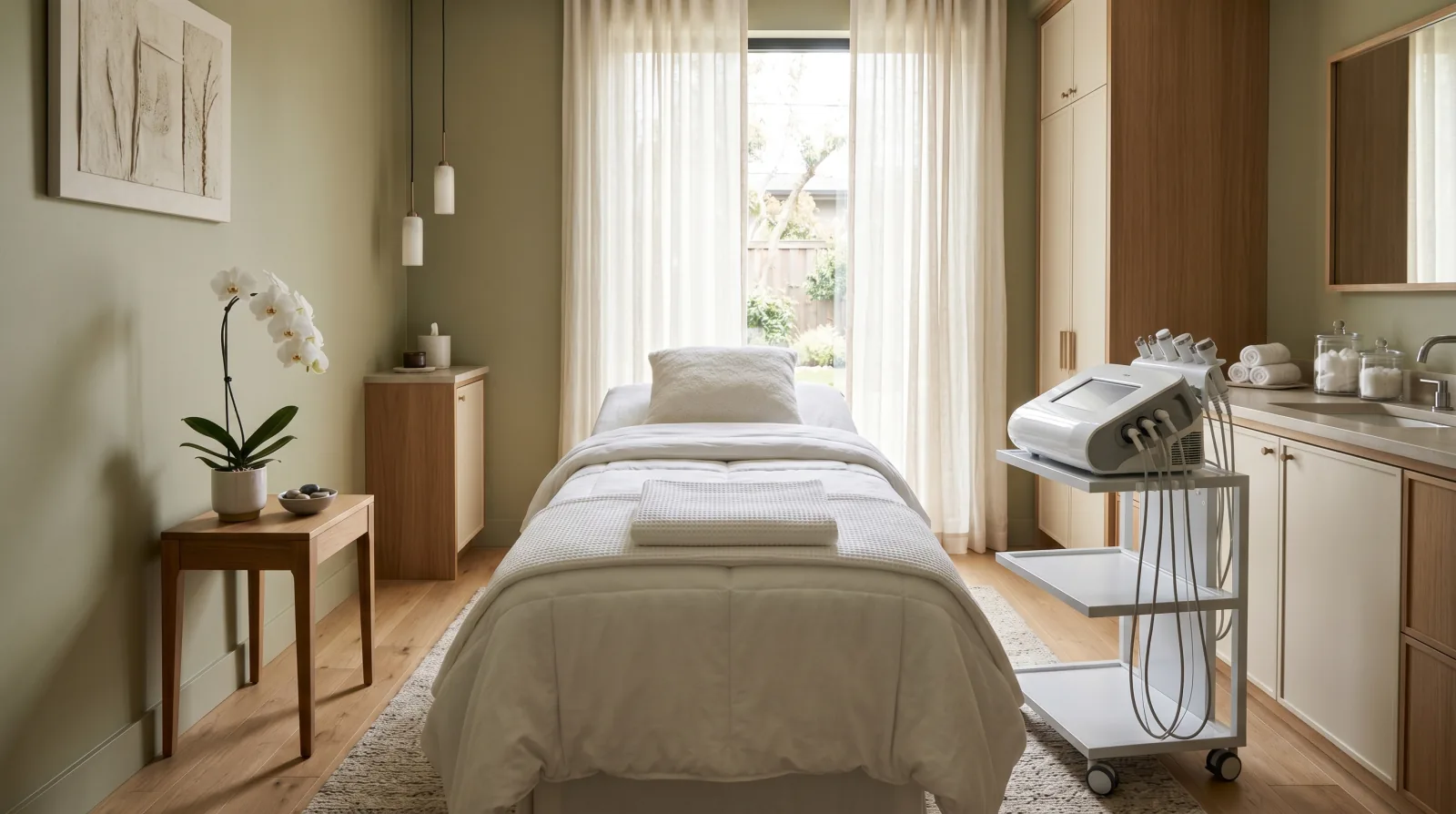
Editorial note: This article covers digital marketing and SEO strategy for med spas. It does not constitute clinical, regulatory, or compliance advice. Rules governing healthcare and aesthetic-medicine advertising vary by jurisdiction; consult your state medical board and relevant advertising standards before implementing any marketing strategy.
There is a moment every med spa owner knows. The calendar for next week shows white space where bookings should be, and a familiar thought arrives: perhaps a promotion. Twenty percent off injectables. A flash sale on laser packages. The bookings come, they always come, and so does the quiet damage: clients trained to wait for the next discount, margins shaved to the bone, and a brand that slowly, almost imperceptibly, repositions itself from medical aesthetics practice to bargain counter.
The truth is, discounting is not a marketing strategy. It is a confession that the right people cannot find you, so you are paying the wrong people to show up. And in a market this crowded, and the American Med Spa Association reports that the medical aesthetics industry has eclipsed $17 billion and is growing by more than a billion dollars per year, being unfindable is no longer a small problem. Every month, in your city, people are searching for exactly the treatments you offer, at full price, ready to book. The only question is whose calendar they land on.
This is what med spa SEO is actually for: not vanity rankings, but filling your book with clients who searched for you on purpose. Let us go through it properly, the way one would explain it to a colleague, not a marketer.
Why Does Discounting Hurt a Med Spa More Than It Helps?
Discounting hurts because it attracts price-shoppers rather than treatment-seekers, conditions existing clients to delay bookings until the next promotion, and erodes the premium positioning that medical aesthetics depends on. A med spa sells expertise and safety; a discount tells the market it sells units of product.
Consider the economics for a moment. Aesthetic treatments are not impulse purchases of strangers; they are recurring relationships. A client who chooses you because of your injector's skill and your reviews will return quarterly for years. A client who chooses you because you were the cheapest this month will leave you the moment someone else is cheaper, which, in this industry, is always next month. You have not acquired a client; you have rented a transaction, and paid for the privilege with your margin.
And there is a subtler cost still. In a field where the service touches a person's face and health, price signals trust. One does not look for the discount neurotoxin the way one looks for a discount sofa. When the lowest price is your loudest message, you are competing in the only race a serious practice should refuse to enter. The alternative is not louder advertising; it is being found, organically and credibly, by people already searching. That is precisely the work of med spa SEO.
What Actually Fills a Med Spa's Booking Calendar in 2026?
In 2026, new med spa clients come from five places: Google's local map pack, your Google Business Profile, your review profile, your website's treatment pages ranking in organic search, and, the newest channel, AI assistants like ChatGPT and Google's AI, which recommend specific practices by name. Instagram still builds desire; Google and AI close the booking.
This distinction matters more than most owners realize. Social media is wonderful for showing your aesthetic and your results, but it reaches people who were not necessarily looking. Search reaches people at the exact moment of intent; someone typing "lip filler near me" or "best med spa for microneedling" has already decided to buy, they are deciding from whom. These are the full-price clients the discount never reaches.
And the deciding vote, almost always, is reviews. BrightLocal's Local Consumer Review Survey 2026 found that 97% of consumers read online reviews when choosing local businesses, and 41% now say they always read them, up sharply from 29% the year before. For a service performed on someone's face, that number is, if anything, an understatement. Your last twenty reviews are your consultation room's first impression, delivered before anyone walks in.
Then there is the new arrival: a growing share of prospective clients now ask an AI assistant directly, for example "Is Botox or Dysport better for me?" or "Who is a reputable med spa near me for laser resurfacing?", and the assistant answers with explanations and, increasingly, with names. We will come to how those names are chosen. For the adjacent world of salons and day spas, our guide to SEO for salons and spas covers the walk-in side; here we stay with the medical aesthetics practice.
How Do You Make Your Google Business Profile Win Local Searches?
You win local searches by treating your Google Business Profile as your digital reception desk: choose "Medical spa" as your primary category, list every treatment as a service, upload real photos of your space and team weekly, collect and answer reviews systematically, and keep your booking link, hours, and contact details flawlessly accurate.
Why does this deserve such attention? Because for searches like "med spa near me", the map pack sits above everything else, and the three practices inside it receive the great majority of the clicks and calls. Google chooses those three using relevance, proximity, and proximity, and prominence; and two of the three are within your control.
The honest checklist:
- Categories first. Primary category "Medical spa", with secondary categories such as "Skin care clinic", "Laser hair removal service", or "Facial spa" as applicable. Precision wins; vagueness loses.
- Services, exhaustively. Injectables, dermal fillers, laser resurfacing, microneedling, chemical peels, body contouring, IV therapy: each listed with a brief, plain-language description. Google matches these to searches nearly word for word.
- Photos that look like your practice, weekly. Your treatment rooms, your front desk, your practitioners, with consent your results. Not stock imagery of generic serenity; prospective clients can tell, and so can Google. A profile untouched for months reads as a practice that has stopped caring.
- Reviews, systematically. Ask after every successful appointment, ideally by text with a direct link, while the client is still glowing, in both senses. Then respond to every review with warmth and discretion, never confirming any individual was a patient when handling a negative one. Our guide to getting more Google reviews details the exact rhythm.
- Accuracy everywhere. Name, address, phone, booking link: identical across your website, directories, and the profile. Inconsistency reads as unreliability, to Google and to a person about to trust you with their face.
None of this is glamorous. All of it compounds, quietly, week after week, in a way no flash sale ever will.
What Should Your Med Spa Website Actually Do?
Your website has exactly two jobs: convince Google and AI assistants that you are the authoritative medical aesthetics practice in your area, and convert a researching visitor into a booked consultation. Every page should either build that authority or remove a reason to hesitate; anything else is decoration.
The truth is, most med spa websites do neither. They open with a stock photo of orchids and a promise of "rejuvenation", followed by a treatment menu with no depth. Meanwhile the visitor, who is about to entrust her face to a stranger, wants real answers: who will perform this, what are their credentials, what does the treatment actually involve, what will I look like after, and what does it roughly cost?
So structure the site around those questions:
- One substantial page per treatment. A dedicated page for lip filler, another for laser resurfacing, another for microneedling: each answering the questions people genuinely ask, how it works, who is a good candidate, what affects the price, downtime, how long results last. These pages are what rank for "med spa" and treatment searches, and they are precisely what AI assistants quote.
- Practitioner pages with real credentials. This is a medical service; Google and AI systems treat it with the heightened scrutiny they apply to health content. Name your medical director, show your injectors' qualifications, photograph your actual team. Anonymous practices lose, in rankings and in bookings.
- Before-and-after galleries, with consent, organized by treatment. Nothing converts a hesitant visitor like evidence.
- A booking path visible without scrolling, on mobile, on every page. If booking a consultation takes more than two taps, you are donating clients to whoever made it one.
If you would like to see how your current site measures against all of this, you can check your SEO standing for free; it takes about a minute and shows precisely where the gaps are.
How Do You Get Your Med Spa Recommended by ChatGPT?
AI assistants recommend med spas they can read, verify, and trust: treatment pages that answer real questions directly, named practitioners with verifiable credentials, business details consistent everywhere, and a deep review profile in which clients describe specific treatments and outcomes. There is no advertised placement inside an AI answer; it must be earned.
This deserves a moment of reflection, because it is the genuinely new chapter in marketing for med spas. When someone asks ChatGPT or Google's AI which practice to trust for laser resurfacing, the assistant assembles its answer from sources it considers credible: your website's content, your reviews, your practitioners' credentials, mentions of your practice across the web. And because aesthetic medicine touches health, the assistants are measurably more cautious here; they favor practices that demonstrate medical legitimacy, not merely good photography.
The practical moves are these: write each section of your treatment pages so it answers one question completely and stands on its own; publish your medical director and injectors by name, with credentials an outside system can verify; keep your business information identical everywhere it appears; and cultivate reviews with substance; for example, "my injector explained exactly what my forehead needed and the result is subtle" tells an AI assistant far more than five anonymous stars. The practices already appearing in AI answers share one trait, without exception: their websites read like helpful, honest answers from a qualified professional.
What Do Most Med Spa Owners Get Wrong About Marketing?
Most med spa owners get three things wrong: they pour everything into Instagram while neglecting search, they discount to fill slow weeks instead of fixing why the calendar is slow, and they treat their website as a brochure rather than as the asset that Google and AI assistants actually read. All three errors share one root: confusing visibility with being found.
The Instagram error is the most common, and the most understandable; this is a visual industry, and the platform rewards beautiful results. But Instagram reaches people who follow you already or stumble upon you; search reaches the person who decided this morning to finally book that consultation. A practice with forty thousand followers and no presence on page one of Google has built an audience, not a pipeline.
The discounting error we have discussed: it medicates the symptom while the disease, invisibility, progresses.
And the third error is patience, or the lack of it. Med spa SEO compounds the way a loyal client base compounds: slowly at first, then decisively. The treatment page you publish this month may take a season to rank; and then it produces consultations every week for years, at full price, without a single promotion. The owners who win are the ones still doing the unglamorous weekly work in month eight, while their competitors have returned to flash sales.
Is There a Done-for-You Alternative?
There is, and this is the natural place to mention it. Licheo is a done-for-you service that gets local businesses found by more customers on Google and on AI assistants such as ChatGPT. Rather than handing you a dashboard and a list of homework, Licheo's team does the work itself: it audits your website, repairs the technical problems that keep you invisible, builds the treatment and location pages your future clients actually search for, strengthens your Google Business Profile, and structures your content so AI assistants can read it, trust it, and recommend your practice by name. For a med spa owner, the practical difference is simple: you stay with your clients, and the work of being found happens quietly in the background, measured month by month. There is no fixed package to squeeze into; you contact the team, describe your market, and receive a plan built around your practice. You can read how the service works on the done-for-you SEO page.
The honest first step, whether you hire anyone or not, is to know where you stand today. Run the free SEO standings check on your own website, sixty seconds, no commitment, and you will see your practice the way Google and the AI assistants currently see it. And for the complete picture of what matters in this industry specifically, the med spa SEO industry page lays it out end to end.