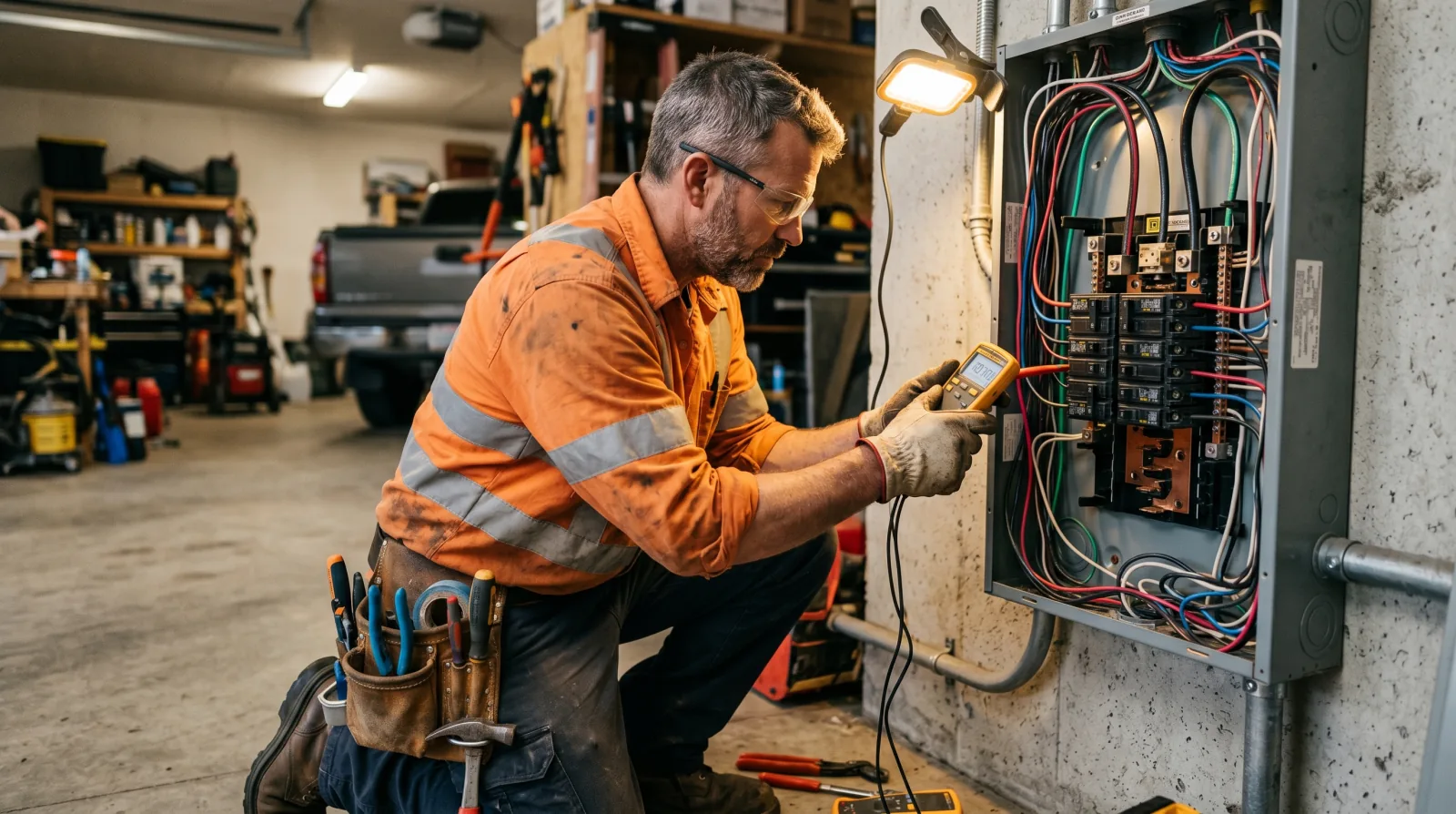
Let me describe a situation that, if you run an electrical business, you will recognize immediately. Your work is solid: clean installs, panels that pass inspection the first time, customers who call you back years later for the next job. And yet the new calls arrive mostly through lead platforms that charge you for every name, send the same homeowner to four of your competitors, and raise their prices whenever you start to depend on them. You are, in effect, renting your own customers, paying a toll job after job on demand that should be coming to you directly. Meanwhile, some competitor with half your experience sits at the top of Google Maps and gets the calls for free.
What does he have that you do not? Not better work, but better visibility in the places where homeowners now make their decisions. This guide explains, in plain language and without a single dollar of ad spend required, how to build that visibility yourself.
Here is the short version, in case you read nothing else. Marketing for electricians in 2026 comes down to five connected assets: a complete and active Google Business Profile that puts you in the map results when someone searches "electrician near me"; a steady flow of recent reviews, not a pile of old ones but fresh ones arriving every week; a website that gets a homeowner from "my outlet is sparking" to your phone number in seconds; pages that answer the questions people actually search, from panel upgrade costs to EV charger installation; and a presence that AI assistants like ChatGPT can find and confidently recommend. Build these five, and the leads stop carrying a per-call price tag.
Why Does Lead Generation Feel More Expensive Every Year?
Because the platforms selling you leads sit between you and the homeowner, and they auction the same customer to several electricians at once. As more contractors compete for the same shared leads, the price per lead rises while the closing rate falls; you pay more, for less, every year. Owning your own visibility is the only durable exit.
Think about what a lead platform actually is: a company that became visible on Google in your trade, in your town, and now sells that visibility back to you one phone call at a time. There is nothing immoral in this, but one must see it clearly. Every dollar you send them is a dollar spent renting a position you could, with patience, own outright.
And the homeowner's behavior has shifted in ways that favor the owner-operator who acts. When someone searches "emergency electrician near me" at nine in the evening, most never scroll past the map with its three highlighted businesses. Reviews decide the choice from there: BrightLocal's 2026 Local Consumer Review Survey found that 31% of consumers will only use a business rated 4.5 stars or higher, nearly double the year before. And a newer door has opened entirely: the same survey found 45% of consumers now use AI tools like ChatGPT for local business recommendations, up from just 6% a year earlier. The decision is being made before anyone visits a website: in the map, in the reviews, and increasingly inside an AI's answer.
The encouraging part? In most service areas, almost no electrician is doing this work seriously. The bar, let's say, is refreshingly low.
What Actually Makes the Phone Ring for an Electrician in 2026?
Five things: ranking in Google's local map results, a strong and recent review profile, a website built to convert an urgent visitor into a call, service pages that answer real homeowner questions, and visibility in AI assistants. Each reinforces the others, and none requires paying per lead.
Let us take them one at a time.
Your Google Business Profile is your storefront. For a trade where nobody walks past your shop window, the map result is the shop window. Categories, service list, hours (especially if you take emergency calls), photos of real jobs, reviews: these decide whether you appear in the map pack for "electrician [your town]." For most electrical contractors, this free profile can produce more calls than the website itself. Our 30-minute Google Business Profile optimization guide walks through the exact setup.
Reviews are your reputation, written down by strangers. A homeowner letting someone work inside their electrical panel wants proof of trustworthiness, and reviews are the proof they trust most. Quantity, star average, and recency all count; and so does your side of the conversation: per BrightLocal, 80% of consumers say they are likely to use a business that responds to all of its reviews.
Your website's job is speed to contact. An electrical visitor is often urgent; something is sparking, tripping, or dead. Your site must show, within one phone screen: what you do, where you work, and a tappable phone number. Everything else is decoration. A beautiful site that hides the number behind a menu loses the call to whoever answers faster.
Service pages earn the searches ads cannot buy cheaply. "How much does a panel upgrade cost," "do I need a permit to add a circuit," "EV charger installation [your town]": each of these deserves its own honest page. This is the core of electrician SEO: one page per service, per question, written plainly, with a price range where you can give one. These pages bring in homeowners at the exact moment of need, and they are precisely what AI assistants quote when asked the same questions.
AI assistants are the new word of mouth. With ChatGPT alone reaching more than 800 million weekly users, a growing share of homeowners simply ask the AI "who is a good electrician near me?", and the AI answers with names, drawn from Google profiles, reviews, and websites. We documented exactly how this works for the trades in how plumbers get recommended by ChatGPT; the mechanics for electricians are identical.
What Can You Do Yourself, Step by Step?
Start with your Google Business Profile, then build a same-day review habit, then make your phone number the most prominent thing on your website, then publish one service or question page per month. An owner spending two hours a week, say one rainy Friday afternoon, can lay the whole foundation in about sixty days.
The sequence I would follow, in order:
- Complete your Google Business Profile entirely. Primary category "Electrician," secondary categories for what you actually do (electric vehicle charging station contractor, lighting contractor). Define your service area honestly, list every service individually, set hours that reflect reality, and if you answer emergencies, say so everywhere.
- Add photos of real work, monthly. The van, the team, a tidy panel after an upgrade, an EV charger install, taken on your phone, on the job. Homeowners distrust stock photos instinctively, and Google rewards fresh uploads. Five minutes at the end of a job, a few times a month.
- Build the review habit. The highest-leverage change in this guide: when a job ends well, ask for the review that same day, by text, with the direct link to your Google review form. Not a sign on the invoice, but a personal text from you or the office. Make it part of closing out every job, the way you make testing part of every install.
- Respond to every review. Briefly and warmly to the kind ones; calmly and factually to the rare bad one. The response is not really for the reviewer; it is for the hundred homeowners who will read it next year.
- Run the phone test on your own website. Search yourself on your phone, tap through, and count the seconds until you could call. If the number is not tappable in the first screen, fix that this week, before anything else on this list.
- Write one page per month answering a real question. Take the question customers ask most, for example "how much to replace a panel?" or "can you add a circuit for a hot tub?", and answer it honestly on its own page, with a realistic range and a clear next step. Twelve months later, twelve pages are quietly generating calls you no longer pay for.
What Do Most Electricians Get Wrong With Marketing?
The most common mistakes are depending entirely on lead platforms, treating the Google profile as a one-time chore, hiding prices, collecting reviews in bursts instead of steadily, and buying a pretty website that buries the phone number. Each one keeps the business renting demand instead of owning it.
A brief story. An electrical contractor I spoke with last year was spending a serious monthly sum on shared leads, and winning perhaps one job in five, because four competitors received the same homeowner's number. His Google profile had eleven reviews, the newest from two years prior, and his website's phone number lived at the bottom of an "About Us" page. The work was excellent; the visibility was an afterthought. He did not have a lead problem. He had an ownership problem.
The patterns repeat:
- All eggs in the lead-platform basket. Useful as a supplement while you build; ruinous as a foundation, because the platform owns the customer relationship and sets the price of your own demand.
- The abandoned profile. Claimed in 2021, untouched since. Google reads inactivity as irrelevance.
- Price secrecy. Electricians fear that publishing ranges scares customers off. The truth is the opposite; the homeowner who cannot find a number does not call to ask, they call the competitor who gave one.
- Review droughts and floods. Twenty reviews in one month after reading an article, then nothing for a year. Steady weekly flow beats bursts, for Google and for trust alike.
- Chasing the whole metro. Trying to rank everywhere instead of dominating the towns you actually drive to. Service-area businesses win by depth, not breadth; we cover this in local SEO for service-area businesses.
What If You Would Rather Stay on the Tools?
A fair question; you became an electrician to do electrical work, not to manage review funnels and service pages, and every hour spent on marketing is an hour off a paying job. The truth is, this is exactly the trade-off Licheo was built to remove: it is a done-for-you service that gets electricians found by more customers, in Google's map results, in classical search, and in AI assistants like ChatGPT, handling the Google Business Profile, the review strategy, the website fixes, and the service pages while you stay on the tools. There is no software to learn and no dashboard to check between jobs; the work is simply done, and reported in plain language you can read in the van. The honest first step costs nothing: check your SEO Standings to see exactly where your business stands today against the other electricians in your service area, showing which of these five assets you already own, and which are quietly sending your calls elsewhere.
For the fuller picture of how search works in this trade, our electrician SEO industry page lays it all out. Pricing is simple: contact us, and we will look at your situation together.