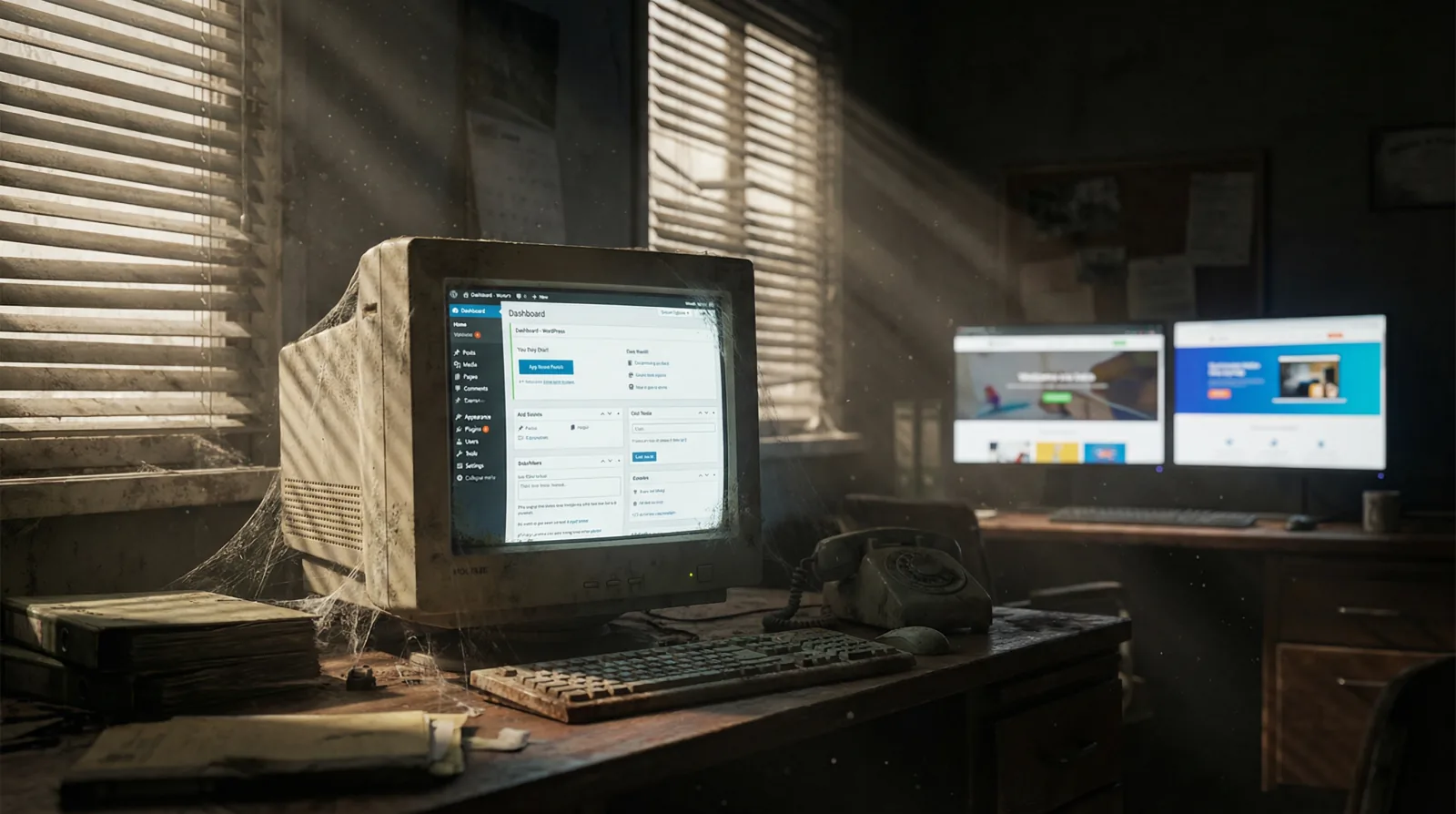
The question arrives in our inbox almost every week now, and it always arrives with a certain anxiety attached to it. Somebody read an article. Somebody at a networking breakfast said the word "dead". And now a person who runs a plumbing company or a dental practice, a person who has no interest whatsoever in content management systems, is worried that the website they paid for four years ago is a liability.
So let me answer plainly, because you deserve a plain answer and not a lecture about software.
In short: WordPress is not going to vanish, and for many small businesses the existing site is perfectly fine. But the platform has genuinely stopped growing, and the practical risk for you is not the platform itself, it is the pile of plugins, updates and neglected maintenance that sits on top of it. Ask four questions about your own site. If the answers are good, keep it and spend your money on getting found instead. If the answers are bad, the site is costing you more than a rebuild would.
First, what actually happened
We wrote a longer piece on the numbers and the history in WordPress is dead, here is what actually killed it, and if you want the full story it is there. The short version: after twenty years of only ever going up, WordPress began to lose ground. Part of this was a public and rather bitter fight inside the ecosystem itself. Part of it was that newer platforms simply produce faster sites with less effort.
But notice what that means and what it does not mean. It means fewer new websites are being built on WordPress. It does not mean your existing site stopped working on a particular Tuesday morning. Millions of businesses are still running perfectly good WordPress sites and will continue to for years.
The mistake people make is treating this as a yes or no question about a platform, when it is really a question about one specific website: yours.
The four questions that actually decide it
Forget the industry drama. Sit down with your own site and answer these honestly.
Can you change your own content? If you want to update your hours, add a new service, or put a photo of the new van on the homepage, can you do it yourself in ten minutes? Or do you have to email somebody, wait three days, and sometimes pay for it? A website you cannot edit is not really yours. It is a brochure somebody else is holding for you.
Is it fast on a phone? Not on your office computer with fibre internet. On a phone, on mobile data, in a car park. This is how most of your customers will see it. If it takes several seconds to show anything, you are losing people before they read a word, and you will also struggle to rank. We explain what to look at in Core Web Vitals explained, and how to fix yours.
Is somebody actually maintaining it? WordPress needs regular updates, to the core software, to the theme, and to every plugin. If nobody has logged in for a year, you do not have a website, you have an unlocked door. This is the single most common problem we find, and it is quiet until it is very loud.
Do you know what you are paying for? Many owners are paying for four or five plugin licences a year and could not say what three of them do. That is not a WordPress problem exactly, but it is a symptom of a site that grew without anybody in charge of it.
If you answered well on all four, your site is fine. Genuinely. Stop worrying about it and go read something about getting more customers instead.
When keeping it is the right decision
There is a version of this article that tells you to rebuild, because rebuilding is what agencies sell. I will not do that, because for a good number of businesses it would be bad advice.
Keep your WordPress site if it loads quickly, if you can edit it, if somebody competent updates it, and if it is bringing you enquiries. A rebuild in that situation is an expense with no return attached. Worse, a badly handled rebuild can lose you the search visibility you spent years building, which is why we wrote a whole website redesign SEO checklist about not throwing that away.
Money spent on being found is almost always worth more than money spent on being rebuilt. A slightly dated site that appears when somebody searches will beat a beautiful new site that nobody can find. Every time.
When leaving is the right decision
Now the other side, honestly.
Leave if the site is slow and two different people have already failed to make it fast. At some point the accumulated weight of theme plus plugins plus old code is not worth unpicking, and starting clean is cheaper than continuing to pay for archaeology.
Leave if you have had a security incident, or if you discover nothing has been updated in a very long time. Cleaning an infected site properly costs more than most owners expect, and the trust damage with Google can take months to repair.
Leave if you are locked out of your own content. If every small change requires a person, a ticket and an invoice, you will simply stop making changes. And a website that never changes slowly stops earning its place in search results, which is a decay we described in why old content stops working.
What most owners get wrong about this decision
Here is the thing I would like you to take away, if you take away only one thing.
Almost nobody loses customers because of the platform their website is built on. They lose customers because the site is slow, because the information on it is out of date, because it does not appear when somebody searches for what they sell, and because the phone number is buried at the bottom of a page.
None of those four problems are WordPress problems. Three of them exist just as easily on Wix, on Squarespace, on Shopify, on anything. Changing platform without changing any of that is like repainting a shop that has no sign on the street.
So before you spend money on a rebuild, find out what is actually wrong. Our free visibility check looks at your site the way a search engine and an AI assistant look at it, and tells you in plain language what is holding it back. Sometimes the answer really is "this needs to be rebuilt". Very often the answer is "this needs three specific fixes and then some attention", and that is a much smaller bill.
The practical order of operations
If you want a simple sequence, here it is.
First, find out whether you can even be found. If you do not appear for the searches your customers actually type, nothing else matters yet.
Second, check speed and check that somebody is maintaining the site. These two protect what you already have.
Third, make sure you can edit your own content, because you will need to, regularly, forever.
Only then, and only if the first three keep failing, consider changing platform. In that order, the rebuild becomes an informed decision rather than a panic.
In the end
WordPress in 2026 is a mature platform that is past its peak, not a burning building. The businesses that get hurt are not the ones on WordPress. They are the ones on an unmaintained anything, with an old page, a slow phone experience and a name that does not come up when a customer goes looking.
That is a fixable situation, and it is a much cheaper one to fix than most people fear. Start by finding out where you actually stand.