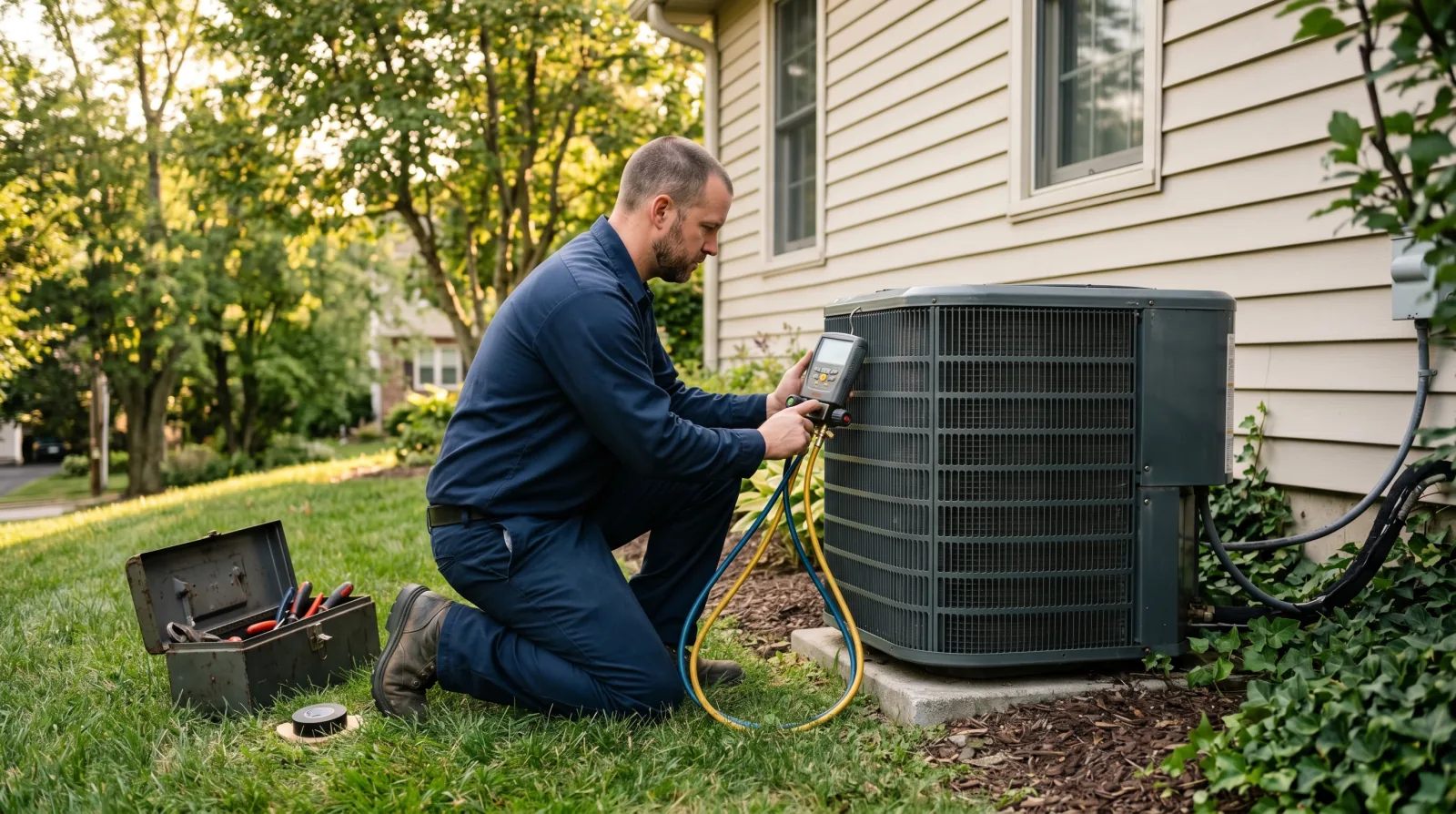
There is a rhythm to this trade that nobody who works in it needs explaining. The cold snap arrives and the phone does not stop. The first hot week and it happens again. And then, between those two, there are weeks where the van sits, the schedule has gaps, and the same thought arrives: we should be doing something about this.
The companies that stay busy through those weeks are not luckier. They are doing two specific things, and neither of them is advertising.
In short: in the quiet weeks you sell maintenance instead of waiting for repair, and you build the visibility that pays out during the next rush. The first fills this month's schedule from customers you already have. The second fills next season's from customers you have not met. Both are cheap. Neither happens by itself.
The reason the phone is quiet is also the opportunity
When nothing is broken, nobody calls. That is the whole mechanism. Demand in this trade is created by discomfort, and in the shoulder months nobody is uncomfortable.
But every system in every home you have ever worked on is one season older than when you last saw it. It needs servicing before it is asked to work hard. And the ideal moment to do that is precisely now, when you have time to schedule it properly and the homeowner is not in a crisis.
The homeowner knows none of this, and will not think of it unaided. They are not going to wake up in April and remember the boiler.
So the quiet season is not an absence of work. It is work that requires somebody to raise the subject. That somebody is you.
Phase one: fill this month from your own list
Contact everybody whose system you know
You have records. Every installation, every repair, every visit. That list is the most valuable marketing asset you own and most companies never use it.
Work through it and contact people whose system is due for a service, in a message that sounds like a person rather than a mailing. Say what you serviced or installed, say roughly how long it has been, and offer a slot. Give a reason that makes sense to a homeowner: catching a small problem now costs less than an emergency callout in January, and a system that has been serviced will not fail on the coldest night of the year.
The response rate on this is far better than anything you could buy, because these people already know you did good work.
Chase the work that was deferred
Every busy season leaves a trail of jobs a customer said no to at the time. Not now, maybe in the spring, let us see how it goes.
It is now the spring. They have forgotten. A short call is not a sales pitch, it is a reminder about something they already said they would consider, and a good portion of that work is still there waiting.
Sell the maintenance plan properly
If you offer a plan, the quiet season is when it sells, because the value is easy to explain when nothing is on fire. If you do not offer one, this is the season to design it.
The argument writes itself for a homeowner: two visits a year, priority when something does break, a discount on parts, no surprise failure in the middle of winter. And for you it converts an unpredictable trade into scheduled revenue and puts you inside the house twice a year, which is where replacement conversations actually begin. We wrote about the economics in HVAC maintenance plans and recurring revenue.
Phase two: build what pays out in the next rush
Here is the part that requires patience, and it is why so few companies do it.
Anything you write today will take weeks to settle into search results. Which means the work you do during the quiet season is not for the quiet season. It is for the first cold week, when the searches arrive in volume and it is far too late to prepare.
Write the pages you are missing
Open your website and count the pages describing one job in depth. Most HVAC companies have a page called Services with a list. That page cannot be found for any of those services.
Write one a week during the quiet. Boiler repair. Boiler installation. Annual servicing. Air conditioning installation. Emergency callouts. Heat pumps, which are increasingly the search that matters. Each page should explain what is involved, how the pricing works, how long it takes, what happens on the day, and the questions homeowners actually ask you.
If you cover several towns, a page for each can work, but only if each one is genuinely written rather than copied with the name swapped. Copies are recognised and ignored, as we describe in service area pages without a doorway penalty.
Get the reviews in before you need them
During the rush you will never ask for reviews, because you are working fourteen hour days. During the quiet you have time to go back to recent customers and ask.
Recency matters. When the cold week arrives and a stranger is comparing three companies on a phone at ten at night, the one with reviews from last month wins the comparison against the one whose reviews stopped last year.
Prepare the emergency page now
When a boiler fails in January, the person searching is cold, worried, and has no patience at all. That page should exist already, with your number at the top, your genuine out of hours availability, what you charge for an emergency visit, and how quickly you can usually get there.
Write it in April. Use it in January.
The profile detail that costs you every winter
One specific thing, because it is common and it is quietly expensive.
If you answer emergency calls in the evening but your Google Business Profile shows you closed at six, every evening emergency in your area goes to somebody else. Check your hours today, set the out of hours availability correctly, and put it in your description too.
The rest of the profile matters as well, and the walkthrough is in the thirty minute profile fix. But the hours are the one that fails silently.
What a quiet week should actually look like
If you want a shape for it: two mornings on the customer list, contacting people whose systems are due. One hour writing a service page. Twenty minutes asking recent customers for reviews. Half an hour taking photographs of finished work for your profile.
That is under a day a week, and it converts the least profitable weeks of your year into preparation for the most profitable ones.
Know where you are starting from
Before you begin, find out what a homeowner in your area currently sees when they search for heating help. Our free visibility check tells you in plain language which searches you appear for, what your profile looks like to a stranger, and which pages are missing.
The companies that are busy in January are not the ones who advertised in January. They are the ones who wrote the page and collected the reviews in the quiet weeks, when nobody was watching and nothing was urgent.