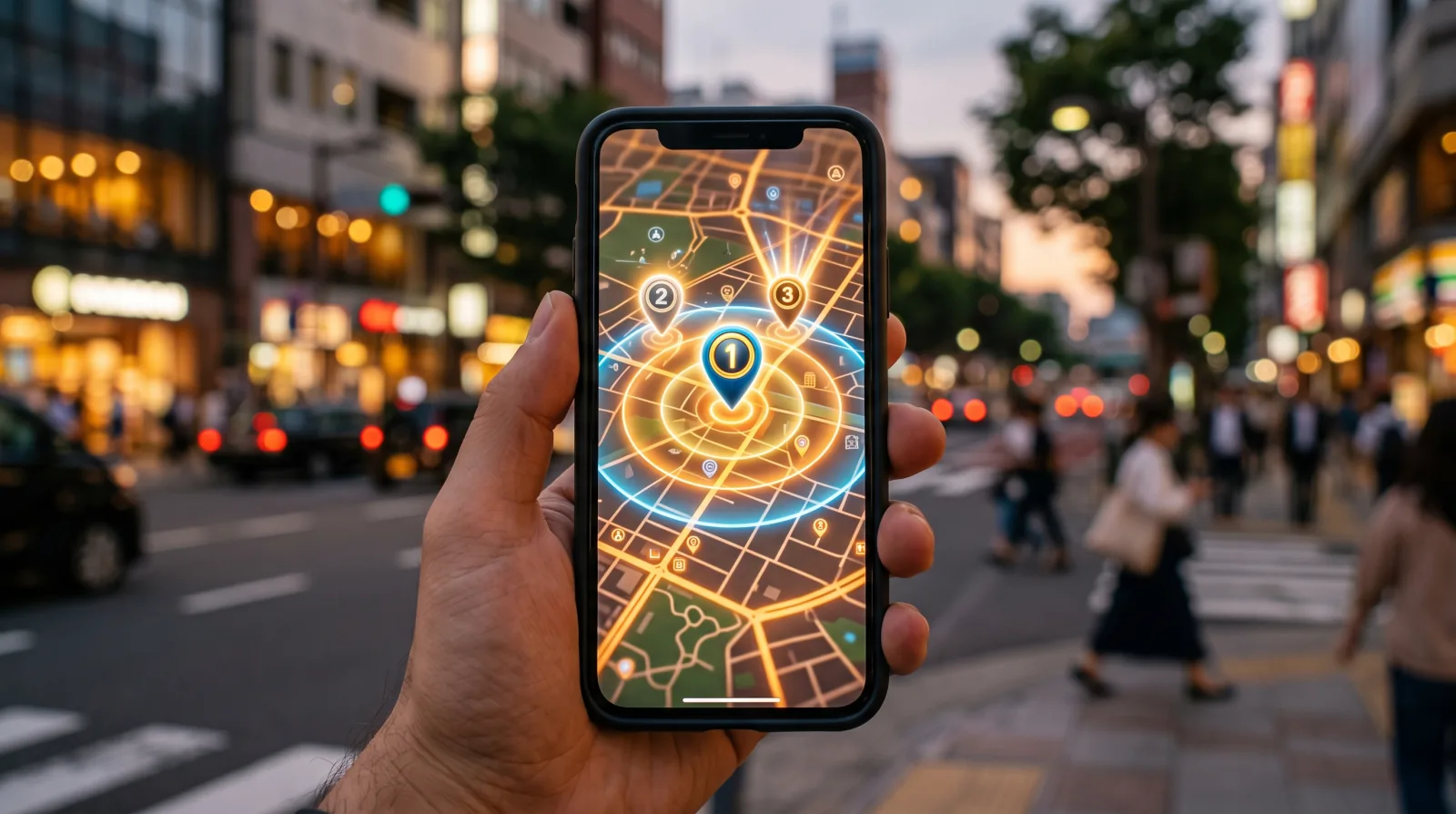
Every local business owner I have ever spoken with wants the same thing, and they usually describe it the same way: "I want to be in the top three on the map." That little box of three businesses that sits above everything else when you search for a local service (the map pack, the local pack, the 3-pack, whatever you wish to call it), is the most valuable real estate in local search. And there is a peculiar mythology around how to get there, most of it wrong.
So let us do something refreshingly simple. Let us look at what Google itself says, add what the most credible research confirms, and separate honestly the things you can control from the things you cannot. Because the truth is, half the frustration in local SEO comes from businesses pouring effort into factors that were never going to move, while neglecting the ones that actually would.
The short version: Google ranks Maps results on three stated factors: relevance, distance, and prominence. Distance (proximity) is largely fixed and, since Google's Vicinity update, weighs more heavily than it used to, which limits how far your reach can stretch. Relevance comes chiefly from your primary category and the content matching a search. Prominence comes chiefly from reviews and genuine online trust built over time. The most reputable research finds that the great majority of the strongest map-pack signals come directly from your Google Business Profile. So the work is clear: perfect the profile, choose categories precisely, and build reviews and relevance patiently.
What Are the Three Factors Google Actually Uses?
Google does not keep this a secret, which is remarkable given how much mystery gets manufactured around it. In its official Business Profile help documentation, Google states plainly that local results are based on three things.
Relevance: in Google's words, "how well a Business Profile matches what someone is searching for." If a person searches for "Thai restaurant" and you are a Thai restaurant, you are relevant. If your profile says only "restaurant," you are relevant to a broader, vaguer set of searches and less relevant to the specific one.
Distance: "how far each business is from the customer who's searching." This is the proximity factor, and it is the one that surprises and frustrates people most, so we will return to it below.
Prominence: "how well-known a business is." Google notes that prominence draws on information from across the web, and adds directly that "more reviews and positive ratings can help your business's local ranking."
Three factors. Stated openly. Everything else you read about Google Maps ranking is, in the end, a detail that ladders up into one of these three.
Why Can't I Rank in a Town Two Cities Away? (The Proximity Problem)
This is the hardest truth to accept, so let us face it directly. Distance is largely fixed. Your business sits where it sits, and you cannot pick it up and place it next to every searcher who might want you.
And here is the part that changed the game: in December 2021, Google rolled out what became known as the Vicinity update, which Google itself described as the largest local search algorithm change in five years. Its effect was to make distance weigh more heavily than before. Prior to Vicinity, a beautifully optimized listing could more easily overcome a distance disadvantage and outrank a closer but weaker competitor. After Vicinity, that became much harder. Proximity now sets real limits.
What does this mean in practice? It means a searcher in the north of a city may simply never see the excellent business in the far south, not because that business did anything wrong, but because a closer, adequately-optimized competitor satisfies Google's sense of "near." No amount of clever SEO fully overrides physics and Google's proximity weighting.
This sounds like bad news, but I would argue it is clarifying, even liberating. It tells you to stop wasting energy trying to rank everywhere, and instead to be genuinely dominant where you can reasonably appear. For service-area businesses that go to the customer, the strategy differs somewhat, and we cover that specific situation in our guide to local SEO for service area businesses. But for a business with a physical storefront, accept the proximity limits with grace and pour your effort into the two factors you truly control.
How Do I Actually Improve Relevance?
Relevance is the factor most within your reach, and the single most powerful lever inside it is your primary category. This is not a small setting to click through carelessly. Your primary category tells Google, in the clearest possible terms, what you fundamentally are.
Choose it precisely. "Italian restaurant" will serve you far better for the searches that matter than the generic "restaurant." "Emergency plumber" or "Roofing contractor" speaks directly to the intent behind a search. Then add secondary categories for the other genuine services you offer, but never dilute your primary one; it carries the most weight by a wide margin.
Beyond category, relevance is reinforced by the actual content of your profile and website: the services you list, the descriptions you write, the words a real customer would use to describe their need. If you offer a service, say so, in the language people search for. This is the same principle that underlies the whole discipline, and if you want the full checklist of relevance signals to tighten, our local SEO checklist for small business is the most complete starting point.
How Do I Build Prominence, and How Long Does It Take?
Prominence is the slow-cooked factor. It cannot be rushed, cannot be bought outright, and rewards patience above cleverness. Its most visible ingredient is reviews.
Reviews contribute to prominence in three dimensions: how many you have, how high your rating is, and how fresh they are. All three matter. According to BrightLocal's 2026 Local Consumer Review Survey, 97% of consumers read online reviews, 68% require at least a four-star rating, and 74% only trust reviews written within the last three months. Research on the map pack specifically suggests that ratings dropping below roughly 3.9 stars noticeably suppress visibility, while a rating comfortably above four sits in the healthy zone.
But reviews are not the whole of prominence. Google also weighs how well-known your business is across the wider web, including mentions of your name, address, and phone number on other reputable sites (what the industry calls citations), links pointing to your website, and general signals that you are a real, established, talked-about business. This is why a business that has quietly done everything right for two years outranks a newcomer who did everything right last month. Prominence is, in a very real sense, the accumulation of time and consistency.
If reviews are where you are weakest, and for most businesses they are, that is exactly where to begin, because the return is greatest there.
Which Factors Come From the Google Business Profile Itself?
Here is a finding that ought to reshape how you spend your effort. According to the well-regarded Whitespark 2026 Local Search Ranking Factors research, the great majority of the strongest signals in the map pack and Maps category come directly from the Google Business Profile itself. Not from your website. Not from elaborate off-site campaigns. From the profile.
This is genuinely good news, because the profile is the thing most within your control and the thing most businesses neglect most badly. So here is a practical order of operations, from highest to lowest return.
- Set your primary category with precision, and add accurate secondary categories.
- Complete every field (hours, service area, attributes, description, phone, website), leaving nothing blank.
- Build and maintain fresh reviews, with a genuine, ongoing system rather than a one-time push.
- Add real photos regularly, which signal an active, real business.
- Keep your name, address, and phone number identical everywhere they appear online.
- Post updates and answer questions to keep the profile alive and engaged.
Notice what is not at the top of that list: no secret hacks, no tricks, no gaming. Just the disciplined, complete, honest management of the profile Google literally built to rank you. For the profile itself, our Google Business Profile optimization guide for 2026 walks through every field in order.
A Quick Story From the Field
I once spoke with a business owner who was convinced, absolutely convinced, that his competitor was doing something sneaky. "There's no way they should be above me," he insisted. "My website is better, my work is better, I've been here longer." He wanted to know the trick, the hack, the thing the competitor had surely paid for.
So we looked, together. And it was almost anticlimactic. The competitor had chosen a sharper, more specific primary category. They had eighty recent reviews to his twenty mostly-old ones. Their profile was complete to the last field; his had three blank sections and a phone number that did not match his website. There was no trick. There was only the boring, controllable work, done, and on his side, not done.
He was quiet for a moment, then laughed and said, "So the secret is that there's no secret." Exactly. That, in the end, is the most useful thing I can tell any local business about Google Maps.
Google Maps ranking is not a mystery to be cracked; it is a discipline to be practiced. If you would like a clear, honest read on where your business currently stands across relevance, prominence, and the profile signals that matter most, see your SEO standings. And if you would rather have experienced people simply do the patient, controllable work for you, our done-for-you SEO service exists for exactly that. There is no secret; only the work, done properly.