You typed your address into a box on a website. A progress bar moved. And then a number appeared, in red, with a list of problems underneath it, and a form asking for your name and telephone number so somebody can explain what it all means.
Were you just diagnosed, or were you just sold to?
Sometimes the first. Often the second. And since we run one of these tools ourselves, I am going to be direct about how they work, including where ours has the same limitations as everybody else's.
In short: a checker can measure things a machine can measure, which is genuinely useful. It cannot judge whether your pages answer what customers actually ask, which is where most small business websites fail. Use them for the technical picture, ignore the drama in the score, and lean on the free tools from Google for anything you want to be certain about.
What these tools can genuinely see
A checker visits your site and inspects it the way a search engine would. What it can measure reliably is real, and worth knowing.
Whether the page has a title and description, and whether they are sensible. Whether headings are used properly. Whether images have descriptions attached. Whether the site loads over a secure connection. Roughly how quickly a page appears. Whether there is a sitemap and whether the robots file is blocking anything. Whether structured data is present. Whether the site behaves on a phone. Sometimes, whether search engines have your pages at all.
That list has value. Several items on it, particularly blocked pages and a site that is slow on a phone, are the sort of thing that quietly costs a business money for years.
What no checker can see
Now the limits, which are larger than the marketing suggests.
Whether your page is a good answer. A machine cannot tell whether your description of a service is more useful than your competitor's. That judgement is the thing that actually decides rankings now, and no automated score touches it.
Whether the right pages exist. This is the most common problem we find in small business websites, and most checkers cannot see it at all. They inspect the pages you have. They cannot tell you about the page you never wrote for the service that earns you the most money.
Whether your local presence is working. Your Google Business Profile, your reviews, your consistency across directories. For a local business this is often the majority of the picture, and a website checker looking only at your website is examining the smaller half.
Anything about your business. Your prices, your reputation, whether the phone gets answered. A website can score highly and belong to a business that is losing customers for reasons no tool will ever detect.
How to tell a diagnosis from a sales mechanism
Four signs, and they are reliable.
Does it tell you what is wrong, specifically? A real report names the problem and where it is. "Your service pages have no descriptions" is useful. "Your on-page optimisation needs improvement" is a conversation starter dressed as a finding.
Does it tell you how to fix it? A tool confident in its own value explains the fix, including the ones you could do yourself. A tool designed to generate calls keeps the fix behind a form.
Does the score seem designed to alarm? Some tools grade so harshly that almost every website receives a poor result, because a poor result produces a phone call. If you test three sites you know to be well built and all three come back badly, you have learned about the tool rather than about the sites.
Does it demand your details before showing anything? Wanting your email in exchange for a full report is normal and fair. Refusing to show you a single finding until you provide a phone number is a lead form with a progress bar attached.
An honest word about our own
We offer a check on this website, so it would be poor form to write this article without saying where ours sits.
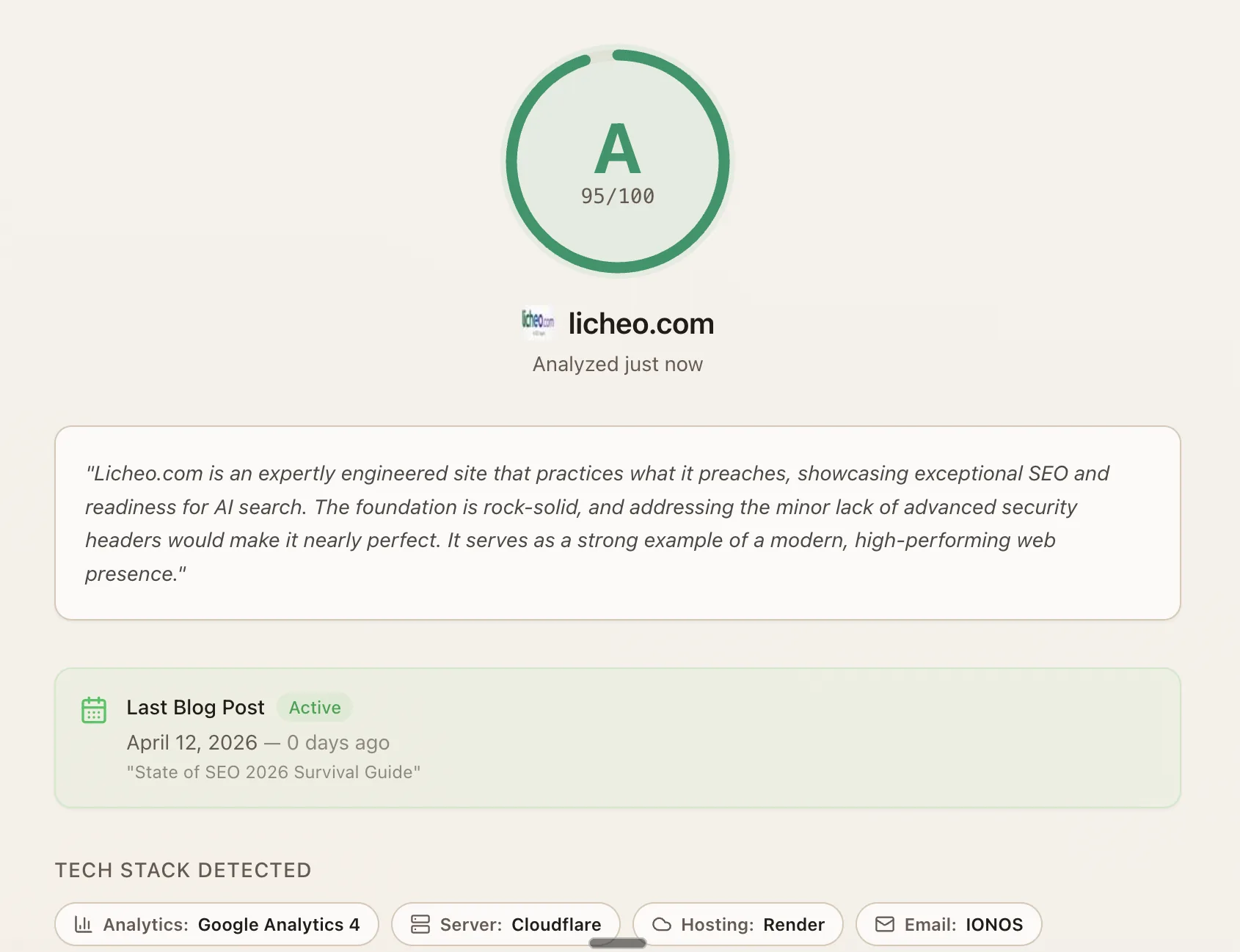
Ours does look wider than most, because it examines your local presence and how AI assistants see your business, not only the technical condition of the pages. It reports in plain language rather than in vocabulary you would need to look up. And it names the specific fixes, including the ones you can do yourself for nothing, because we would rather be useful than mysterious.
What it still cannot do is read your industry, judge whether your prices are right, or know whether your best service has no page because you never wrote one, unless the absence is visible from the outside. No automated tool can. If anyone tells you otherwise about theirs, be careful.
That is the honest position. Use it for the picture it gives, which is a good one, and treat the score as a starting point rather than a verdict. You can see what it produces at the free visibility check.
The four free checks that need no tool at all
If you want certainty rather than a score, these four come directly from the source and cost nothing.
Google Search Console. Google's own record of which searches showed your site, how many people clicked, and what your average position was. This is the most valuable free tool available to a small business and most have never opened it. Our guide is Google Search Console for small business.
The site: search. Type site: followed by your address into Google. If your pages appear, Google has them. If they do not, nothing else matters until that is fixed.
PageSpeed Insights. Google's own speed measurement. Look at the mobile result, not the desktop one.
Your Google Business Profile performance view. How many people found you, called you, and asked for directions. For a local business these numbers often matter more than anything on the website.
How to use a checker sensibly
Run one. Read it. Then sort the findings into three piles.
Things that stop you being found at all. Blocked pages, missing pages, a site search engines cannot read. Fix these first, always.
Things that lose visitors. A slow site on a phone, a broken layout, a phone number that cannot be tapped. Fix these second.
Everything else. Most reports contain a long tail of minor technical items included to make the report look thorough. They are not wrong, they are simply not where your problem is. They can wait, possibly forever.
And then ask the question no checker will ask you: does my website actually have a page for each thing I want to be hired for, written in the words a customer would use?
For most small businesses, that single question is worth more than every automated score they will ever receive.