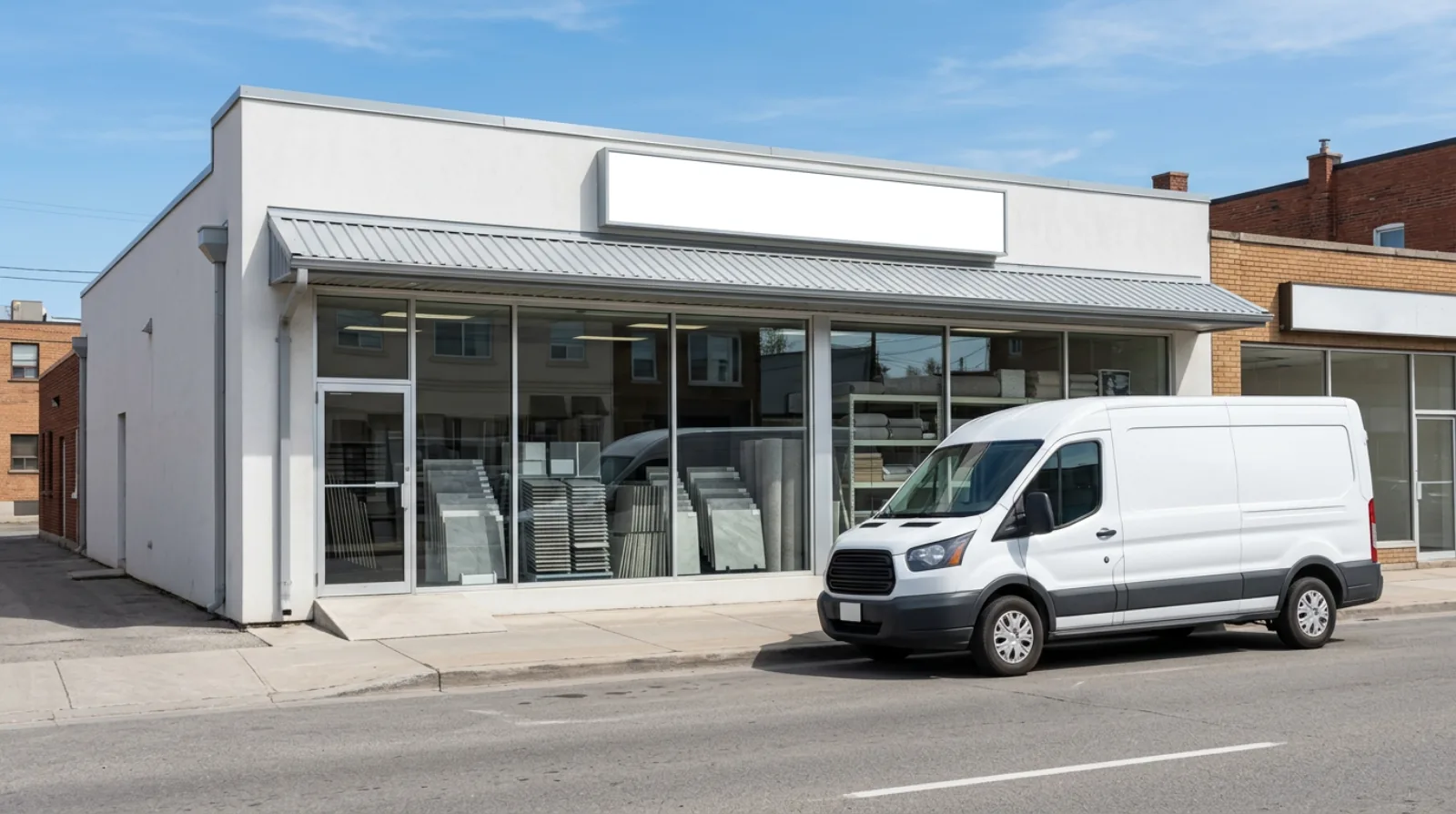
The flooring trade has two kinds of business that look alike from the outside. One has a showroom on a busy road, with sample boards on the walls and a counter. The other is an installer, or a small crew, working from a van and a garage, who brings samples to the customer's kitchen table.
Both want the same thing: to be the company a homeowner finds on Google Maps, and the name ChatGPT or Gemini gives. Google treats them differently, though, and the rules decide what each one may show.
What does Google allow a flooring showroom to show?
A showroom that receives customers during its hours, with signage, is a storefront in Google's terms. Its Google Business Profile, the free listing that shows a business on Google Maps, shows the address, the hours, the photos and the reviews.
A flooring store that also sends crews to install in customers' homes is what Google calls a hybrid: the business "can show their storefront address and designate a service area", but if it does, the location "should be staffed by your team and able to receive customers during its stated hours." For a showroom with a crew, that is the normal case.
What does Google allow an installer without a showroom?
An installer who travels to customers and has no storefront is what Google calls a service-area business. The guidelines are direct: "If you're a service-area business, you should hide your business address from customers." The profile shows a service area instead, the towns or areas where the crew works.
How large may it be? Google's guidelines say the service area "shouldn't extend farther than about 2 hours of driving time from where your business is based", and add that "for some businesses, larger service areas may be appropriate".
Two shortcuts are not allowed. A rented mailing address where the business does not operate, which Google calls a virtual office, "isn't eligible for a Business Profile". A co-working desk is allowed only with clear signage, customers received there during business hours, and the business's own staff present during those hours.
| How the company works | Address on the profile | Service area |
|---|---|---|
| Showroom only, customers come in | Shown | Not needed |
| Showroom plus crews that install in homes | Shown | Set, up to Google's guideline of about 2 hours of driving |
| Installer from home or a warehouse, no storefront | Hidden | Set, up to Google's guideline of about 2 hours of driving |
| Mailing address only | Not eligible | Not eligible |
What may the name say, for either kind?
The rule is the same for both. Google says the name should "reflect your business's real-world name, as used consistently on your storefront, website, stationery, and as known to customers", and that "including unnecessary information in your business name isn't permitted, and could result in the suspension of your Business Profile."
So "Smith Flooring" stays "Smith Flooring". The words "hardwood", "LVP", "Calgary" and "best prices" belong in the services list, the description and the website.
How does Google choose who appears on the map?
Google states it in one line: "Local results are mainly based on relevance, distance, and popularity." Distance is how far the business is from the person searching, and no owner can change it.
Relevance and prominence are where both can work. Google's help page says that "businesses with complete and accurate info are more likely to show up in local search results", and that prominence depends on information like "how many websites link to your business and how many reviews you have." A showroom and an installer can work on these two in the same way: a complete profile, reviews that describe real jobs, and a website that other sites link to.
What did Gemini repeat about showrooms and installers?
On November 8, 2026 we asked Gemini, with Google Search turned on, 20 questions about flooring companies in 10 cities in the United States and Canada, and read every statement it linked to a company's own website (the full test).
Showrooms came back when websites described them: "They have showrooms in Charlotte and Indian Land, SC." "You can visit their showroom or schedule a consultation with their LVP experts." So did the installer's version of the same service: "[Company] offers the convenience of bringing their showroom to your doorstep, providing transparent pricing and on-the-spot measurements." "This company provides a convenient in-home shopping experience, bringing LVP samples directly to you."
What every one of the 20 answers used was at least one flooring company's website. Of 390 statements in the answers, 281 rested only on company websites. Whether a showroom helps a company be named is outside what our test can measure. The test shows that a website stating the facts is something both kinds of business can have, and that the assistant used it.
What should each kind of company put on its website?
A flooring store with a showroom
- the showroom address and hours, exactly as on the Google profile;
- the brands on display, by name, in text;
- whether the store installs, with its own crews or subcontractors;
- the towns where its crews install, by name;
- a page for each floor sold, with projects.
An installer without a showroom
- the towns served, by name, on the homepage and a towns page;
- how the in-home estimate works: samples brought, measuring, written quote and its timing;
- the floors installed, and the brands the installer can supply;
- the crew, its training and how long it has worked together;
- project pages with photos and the town, which take the place of a showroom as proof of the work.
Both kinds of company
Both need the year started, the warranty with its length, the steps of the job, and the same name and phone number as the Google profile, Houzz, HomeStars or Angi, and the Better Business Bureau. Our guide on Google Business Profile for flooring companies covers the profile field by field.
Which mistakes cost each kind of company?
For the showroom: hours on the website that disagree with the profile, a closed showroom still listed, or brands shown only as logos.
For the installer: a home address shown on the profile against Google's guideline, a service area drawn far beyond the towns the crew works in, a second profile made to appear in another town, or a website that never names a single town.
For both: service words added to the business name, which Google says can lead to suspension.
Where to go from here
Whichever kind of company you run, the order of work is the same: the website facts first, then the profile, then the reviews and directories. The whole plan is in our flooring company marketing hub.
At Licheo we build websites for small businesses, make them rank on Google and make them readable for AI assistants, as one monthly service; contact us for pricing. To see where your website stands today, run the free Get Found Check. It returns a letter grade with three to five quick fixes in under 60 seconds.
Sources
- Guidelines for representing your business on Google, Google Business Profile Help, accessed November 8, 2026.
- Tips to improve your local ranking on Google, Google Business Profile Help, accessed November 8, 2026.
- Licheo test of Gemini 2.5 Pro with grounding in Google Search: 20 questions about flooring companies in 10 cities, run on November 8, 2026. Quotations are from statements Gemini linked only to flooring companies' own websites; company names replaced by [Company].