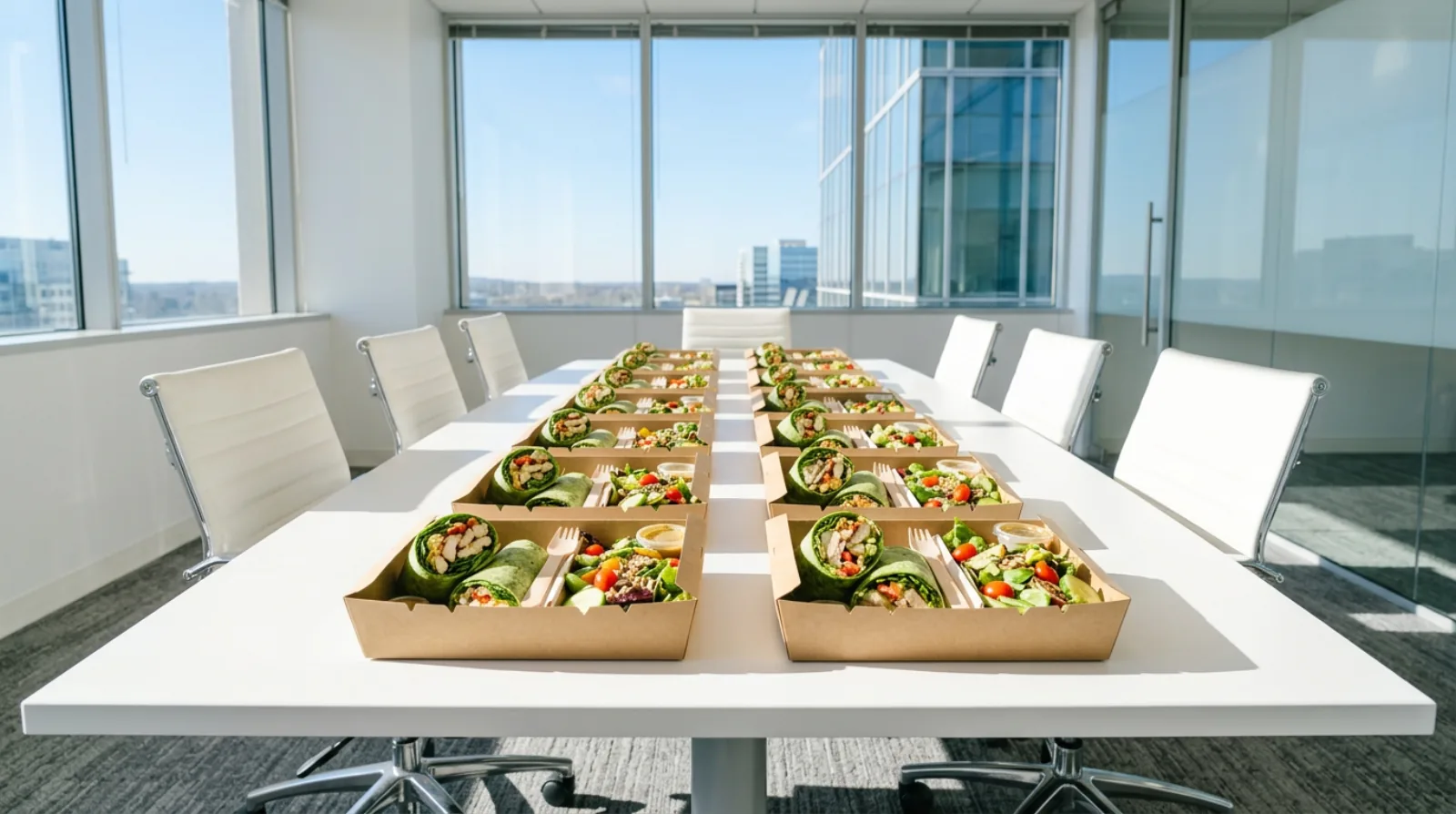
The office manager has a meeting on Thursday, 30 people, two vegetarians, one person who cannot eat gluten, a budget. That is the whole brief. Increasingly, that brief goes straight into an assistant.
We gave Gemini the same brief. On November 9, 2026, we asked Gemini 2.5 Pro with Google Search turned on: "Which catering company should I use for office lunches for 30 people in [city]? Give me a few names." We asked in Vancouver, Toronto, Calgary, Phoenix and Tampa, and we read how each answer was built.
Gemini links each sentence it writes to the pages that support it. That lets us see where the facts came from, and which facts it chose.
Where did Gemini look?
It ran 13 Google searches across the five cities. They were close to what an office manager would type: "best office lunch catering Calgary for 30 people", "corporate catering services Toronto reviews", "best corporate caterers in Phoenix Arizona". In Tampa it did something worth noticing: after finding a few caterers, it searched each one's name followed by "reviews" before including it. A caterer's reputation was checked by name.
Across the five answers Gemini cited 44 sources. 36 were the websites of caterers and other food and event businesses, including one national sandwich chain. The other 8 went to a catering marketplace, an office ordering platform, an event directory, a city news list, a payments company's blog, a wedding directory and a Reddit thread.
Then the statements. Gemini wrote 78 statements linked to sources. 59 rested only on caterers' own websites. 12 rested only on marketplaces, directories and lists, and 7 on both.
What did it repeat?
We sorted the 59 statements from caterers' websites by kind of fact, counting a statement for a kind when it used one of that kind's words. One statement can carry more than one kind.
| Kind of fact | Statements (of 59) |
|---|---|
| Menu formats: boxed lunches, platters, buffet, hot meals, salads | 20 |
| Ordering, notice, minimum order, delivery, setup | 14 |
| Cuisine and ingredients: local, from scratch, Mediterranean, BBQ | 12 |
| Dietary needs | 8 |
| Years in business | 4 |
| Reviews written on the caterer's own site | 3 |
Some of these statements, with names removed as we do in all our tests: one caterer provides "individually boxed lunches, fresh salads, hot meals, and shareable platters, with a minimum order of $160 for drop-off delivery". Another offers "delivery anywhere in Calgary for orders over $100." A third can "tailor menus to your specific needs and dietary restrictions." Another was described as "known for its commitment to using local, Alberta-grown ingredients and creating custom, from-scratch menus." And one caterer had published a price for a sampler package for 30 people, which can be "ordered online with 24 hours' notice."
Look at what these have in common: they are the logistics. Format, minimum, delivery, notice, diet. An office buyer is solving a logistics problem, and the assistant repeated the caterers that had written down the logistics.
What does a catering website need for office clients?
A corporate catering page separate from weddings. Many caterers mix weddings, private parties and office lunch on one page. The office buyer has different questions. A page called "Office lunch catering in [city]" with its own menu and terms answers them directly.
The menu formats, in words. Boxed individual lunches, sandwich and wrap platters, hot buffet, salad bars, breakfast trays. Gemini repeated menu formats in 20 statements. If your menu exists only as a PDF or as photos of trays, write a short version in text on the page. A program reads words more reliably than a scanned PDF.
The ordering rules. Minimum order. How much notice you need (24 hours? 48?). Delivery area and delivery fee. Whether you set up, serve and clear. Whether you deliver early in the morning. These appeared in 14 statements, and they are exactly what an office manager asks on the phone.
Dietary options, honestly. Which needs you can meet (vegetarian, vegan, gluten-free, halal, nut-free) and how meals are labelled. Individually packaged meals came up as a way to manage restrictions. Only list what you truly can do: a mistake here can harm a guest's health.
What you cook, and where it comes from. Twelve statements described cuisine and ingredients: local produce, from-scratch cooking, a Mediterranean focus, BBQ. Your style is your difference from the national chains; write it in a sentence.
Price information. Whether to publish prices is the owner's choice. But the test shows that published figures, such as a minimum order, a delivery threshold or a package price, are repeated by the assistant when they exist. At the least, give a per-person range for a standard boxed lunch, or the price of your most common package.
A quote form built for offices. Date, time, number of people, budget per person, dietary needs, delivery address, and a phone number. Short. An office manager filling a quote request at 4 p.m. on a Tuesday will not complete a twelve-field form.
Marketplaces and directories
A catering marketplace was cited in the Tampa answer and an office ordering platform in the Toronto answer. Both are places where office buyers order directly. If you sell through them, keep your menu and your minimums the same there and on your own site. If the marketplace shows one minimum and your website another, an assistant reading both has to guess.
Reviews matter too, and in a specific way: in Tampa, Gemini searched each caterer's name with "reviews" before naming it. Two Tampa caterers had written their review counts on their own websites ("over 150 five-star reviews", "over 230 five-star Google reviews"), and Gemini repeated them. If you have earned reviews, say so on your site, and keep the number current.
The Business Profile and the menu file
Gemini's searches were Google searches, so the Google Business Profile is part of the picture. Many caterers cook in a commercial kitchen that customers never visit. Google's guidelines say that a service-area business "should hide your business address from customers" and show a service area instead, and that the service area "shouldn't extend farther than about 2 hours of driving time from where your business is based." For an office caterer, the honest service area is usually much smaller: the neighbourhoods you can reach with hot food still hot.
If you have a shop or a café where customers do come, show the address and add the delivery area. In both cases, the hours on the profile should match the hours on the website, including early morning delivery if you offer it.
A word on the menu file. Many caterers keep their full menu in a PDF, designed beautifully for print. Keep it, because people like to download it. But put the headings, the formats, the per-person price range and the dietary symbols on the page itself, as text. An assistant that cannot read the PDF still finds the facts, and a manager on a phone does not have to open a file to see whether you do gluten-free.
One last practical point: write the number of people you can serve. "From 10 to 300 guests" or "office orders from 12 people" tells the buyer, and the assistant, whether you fit a lunch for 30.
What this test does not show
We asked one question, once, in five cities, on one day, to one assistant. Answers change between asks: when we repeated the questions in Vancouver and Phoenix on the same day, only 43% of the business websites cited, across all 20 trades we tested, appeared in both answers. So this test shows where Gemini looks and what it repeats. It cannot rank caterers, and we do not name the caterers in the answers. We did not test ChatGPT this time.
Where to start
Read your corporate page as an office manager with a Thursday meeting. Can you find, in text, the formats, the minimum, the notice, the delivery area, the dietary options and a way to ask for a quote in under a minute? Every missing item is a sentence to write this week.
Our page on marketing for catering companies covers search and reviews in more depth. For the contact side, read what a small business contact page should include to get calls.
At Licheo we build and look after websites for small businesses, so they get found on Google and in AI answers and turn visitors into orders; contact us for pricing. The free Get Found Check reads your homepage and returns a letter grade, with a separate grade for readiness for AI assistants, in under 60 seconds.
Sources
- Licheo test of Gemini 2.5 Pro with grounding in Google Search: the question "Which catering company should I use for office lunches for 30 people in [city]? Give me a few names." asked once in Vancouver, Toronto, Calgary, Phoenix and Tampa on November 9, 2026, with a second ask in Vancouver and Phoenix the same day. Part of a test of 20 trades.