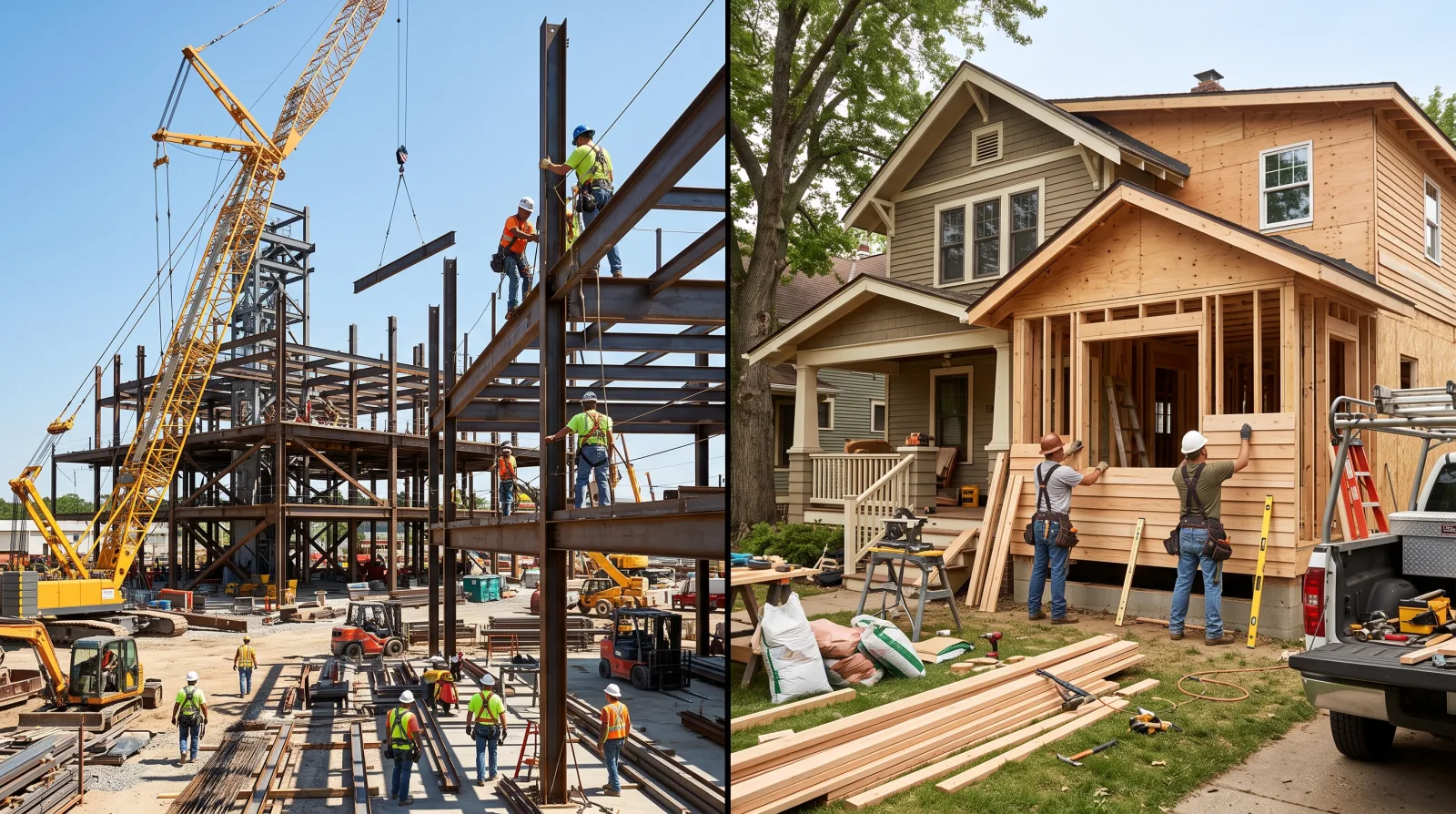
How do you get more work from both homeowners and businesses without losing one to serve the other? Here is a scenario I encounter again and again. A contractor does excellent work for both homeowners and businesses -- perhaps a general contractor who remodels kitchens and also fits out commercial offices, or an electrician who wires new homes and also services warehouses. Naturally, they have one website that tries to speak to everyone at once. And that single, well-meaning website quietly underserves both audiences, because it treats two profoundly different buyers as though they were the same person. They are not. Not remotely.
The homeowner and the commercial buyer live in different worlds. The homeowner is often emotional, local, sometimes urgent -- imagine someone who just discovered a leak, or who has dreamed about their new kitchen for a year. They search "contractor near me," read the reviews, and may well call the same afternoon, deciding within days. The commercial buyer is an entirely different creature: methodical, deliberate, comparison-driven. In fact, research indicates that around 95% of B2B buyers -- businesses buying from other businesses -- conduct online research before making purchasing decisions, and by the time they contact a vendor they are often most of the way through their decision, with requirements already set and a preferred supplier already in mind. One buyer decides with their heart in an afternoon; the other builds a shortlist over weeks, silently, long before you know they exist. A website that tries to address both at once ends up speaking clearly to neither. This guide shows you how to serve each properly, without needing two separate businesses.
In short: Residential and commercial buyers search differently, decide on different timelines, and need entirely different pages, language, and proof. Homeowners are emotional, local, and quick; commercial buyers are methodical, research-heavy, and slow. The solution is not two businesses but one website with two clearly separated paths -- distinct sections, distinct keywords, and distinct evidence tuned to each buyer's real journey.
Why Can't One Set of Pages Serve Both Buyers?
The instinct to write one homepage that welcomes everyone is understandable, but it fails for a reason worth understanding deeply. Search engines and buyers alike reward specificity and relevance. A page that says "we do residential and commercial work of all kinds" is relevant to no particular search, because it matches no particular intent. When a homeowner searches "kitchen remodel contractor," they want a page that speaks entirely about kitchen remodels for homes -- the warmth, the process, the reassurance, the photos of beautiful finished kitchens. When a facilities manager searches "commercial office build-out," they want a page about exactly that -- capabilities, project scale, compliance, timelines, references from comparable jobs.
The two buyers are also persuaded by completely different evidence. The homeowner is reassured by reviews, by photos of finished residential work, by a sense that you are trustworthy people who will treat their home with care. The commercial buyer wants proof of capacity: can you handle a project of this size, on this timeline, with the necessary insurance and safety record and references from businesses like theirs? A single page cannot carry both messages without diluting each. So the foundational principle is separation -- one clearly defined path for each buyer, so that each search lands on a page built precisely for that person.
How Does the Residential Buyer Actually Search and Decide?
The residential buyer's journey is short, emotional, and intensely local. They search with phrases anchored to their location and their immediate need -- "contractor near me," "kitchen remodel [city]," "emergency plumber near me." They are often looking at the results on a phone, and they compare on the things they can quickly assess: your star rating, your recent reviews, your photos, whether you look trustworthy and available. Many will call within a day, and a meaningful share of them decide within days rather than weeks.
To win this buyer, your residential path must be built for speed and reassurance. Dedicated pages for each residential service you offer, written warmly and specifically. A strong, active Google Business Profile, since for local searches that profile is often the first and most decisive thing a homeowner sees. A steady stream of recent reviews, which soothe the natural anxiety a homeowner feels about letting a stranger into their home. Beautiful photos of finished work. Clear, easy ways to contact you immediately. Everything about this path should reduce friction and build trust quickly, because the residential decision is made quickly. For the full picture of winning this kind of local, service-area work, our guide to local SEO for service-area businesses covers the territory thoroughly.
How Does the Commercial Buyer Search and Decide Differently?
Now consider the commercial buyer, and prepare to think about an almost opposite journey. This buyer is rarely acting on emotion or urgency. They are a professional -- a facilities manager, a property developer, a procurement officer -- making a considered decision, often for a substantial sum, that they will have to justify to others. They search differently: broader, more specialized terms, less anchored to "near me" and more anchored to capability, sector, and scale. "Commercial electrical contractor [region]," "tenant improvement contractor," "industrial HVAC installation."
And crucially, as the research shows, they do the great majority of their evaluating quietly, online, before they ever contact you. By the time they reach out -- if they reach out to you at all -- they have likely already formed a shortlist and often have a preferred vendor in mind. This changes everything about what your commercial path must do. It cannot rely on a quick emotional appeal, because there is no quick emotional decision. It must instead survive weeks of methodical scrutiny. That means detailed capability pages, project portfolios with the scale and sector clearly stated, evidence of certifications and safety records, case-study-style descriptions of comparable projects, and clear signals of the professionalism a business client requires. You are not trying to trigger a same-day call; you are trying to earn a place on a shortlist that is being built without your knowledge. For the broader strategy across the trades, our contractors SEO hub brings these threads together.
How Do You Structure One Website to Serve Both?
The practical solution is a clearly forked website -- one business, two well-marked paths. Here is a sensible way to build it:
- Create two distinct sections from the very top of your site. From the homepage, a visitor should immediately see two clear doors: one for homeowners, one for businesses. Do not make them guess which path is theirs.
- Build separate service pages under each section. Residential kitchen remodels live in the residential path, written warmly; commercial fit-outs live in the commercial path, written for capability and scale. The same underlying skill, described entirely differently for each audience.
- Match the language to each buyer. The residential pages speak of care, comfort, trust, and beautiful results. The commercial pages speak of capacity, compliance, timelines, and references. Even when describing similar work, the vocabulary should shift to fit the reader.
- Tune the keywords separately. Residential pages target local, need-anchored, "near me" style searches. Commercial pages target capability-and-sector searches that a professional buyer would use.
- Provide the right proof on each path. Reviews and finished-project photos for residential; project portfolios, certifications, safety records, and business references for commercial.
- Give each path its own clear call to action. For residential, make calling or messaging instant and easy. For commercial, offer a way to request a proposal, a capability statement, or a consultation suited to a longer buying process.
A Short Story About Serving Two Masters Badly -- Then Well
I spoke with a contractor who ran a genuinely capable firm doing both high-end home renovations and commercial tenant improvements. His website, though, had a single homepage that tried to be all things at once, and a jumbled "Services" page listing everything together. He was frustrated: the residential leads that came in felt low-quality, and the commercial work was drying up almost entirely. He assumed the market had softened.
When we looked closely, the problem was not the market -- it was that his one blended message resonated with no one. A homeowner landing on his site saw talk of commercial capacity and safety compliance and felt he was too corporate for their cozy kitchen dream. A commercial buyer saw warm talk of beautiful family kitchens and quietly concluded he was a residential outfit not serious about their build-out. Each audience, seeing the other audience's message, silently ruled him out. We split the site into two clear paths, rewrote the language for each buyer, and gave each the proof it needed. The change was not instant, particularly on the commercial side where the buying cycle is long by nature -- but within a couple of quarters both streams strengthened. He said, with some wonder, that he had not needed to become two businesses; he had only needed to stop asking one page to do two irreconcilable jobs.
What Role Do Reviews and Reputation Play for Each?
For the residential buyer, reviews are close to decisive, because they resolve the emotional question of trust. For the commercial buyer, reviews still matter, but references and demonstrated capability matter more -- a business client wants to speak to comparable clients and see comparable projects. So while you should cultivate reviews for both, weight your evidence accordingly: reviews and testimonials prominent on the residential path, project references and case-study evidence prominent on the commercial path. In both cases, consistency of your core business information across the web quietly underpins everything, because it is how both Google and AI systems confirm you are a real, established firm.
Should You Manage Two Buyer Journeys Yourself?
Serving two entirely different buyers well is, frankly, more work than serving one -- two content strategies, two keyword sets, two kinds of proof, two calls to action, all maintained over time. Most contractors are stretched thin already, running jobs and managing crews, with little room to sustain a properly forked marketing effort.
This is where a done-for-you approach genuinely helps. At Licheo, we build and maintain these two distinct paths so a contractor can capture both the quick emotional homeowner and the slow, methodical commercial buyer, without trying to do it all personally. You can see where your firm currently stands in search with our SEO Standings view, and our done-for-you SEO service handles the ongoing work of serving both markets properly. Contact us and we will show you which buyer your website is actually built for today -- and which one it is quietly losing.
Sources: SmartBuy / Alibaba: What Percent of B2B Buyers Research Online; Demand Gen Report: B2B Buyers and the Buying Journey.